Why Is a Text Message 160 Characters? The Strange History of Length Limits
From a German engineer counting sentences on a typewriter to Twitter's 140 and the telegraph's per-word fees — the surprising stories behind the character limits that quietly shape how we write.
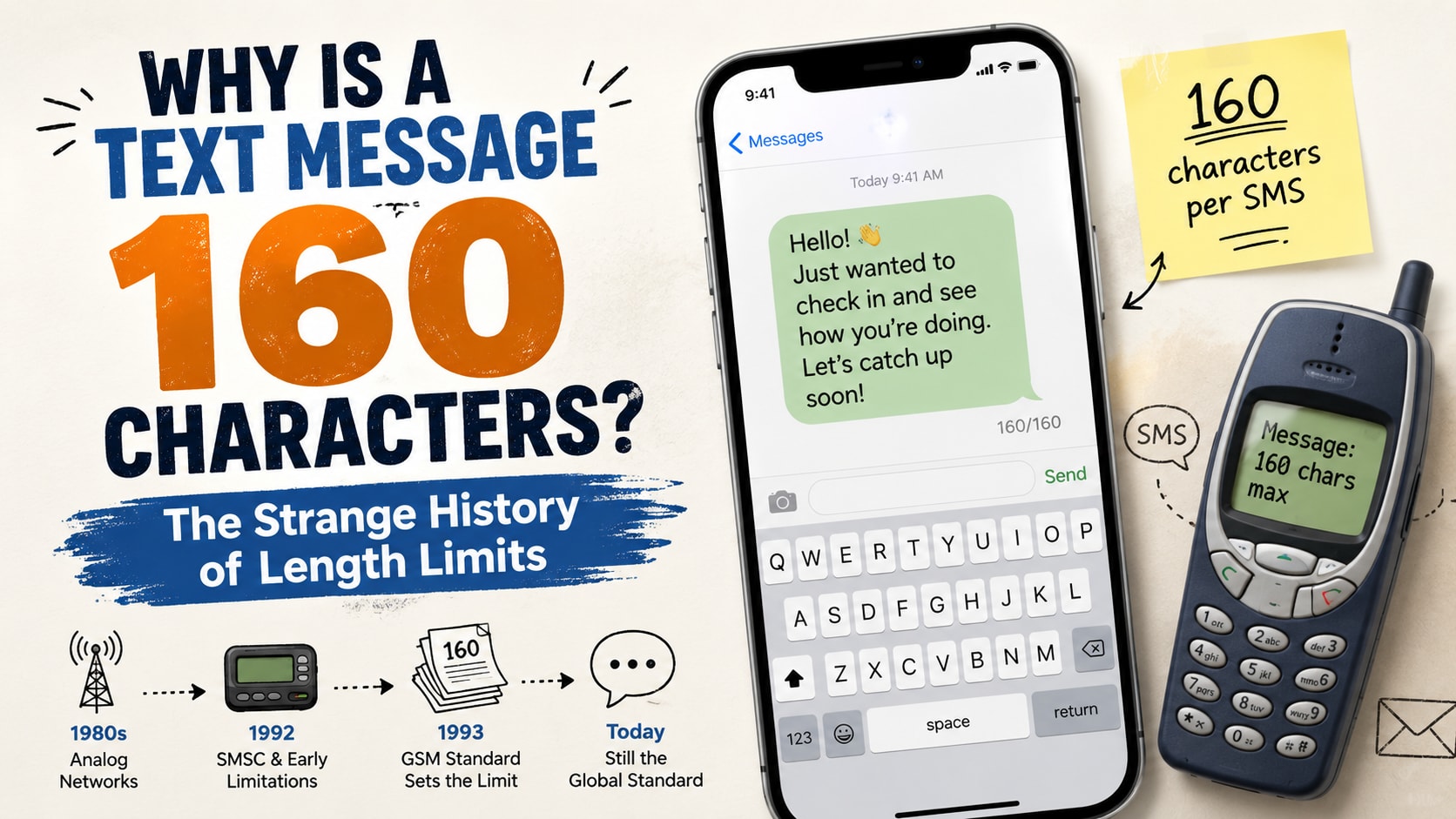
There is a number hiding inside almost everything you type. It decides whether your tweet posts or gets rejected, whether your text arrives as one message or three, and whether the headline you spent an hour polishing shows up whole in Google or gets chopped off with a lonely ellipsis. That number is a character limit, and the strange thing about character limits is that almost none of them were chosen for the reason you'd guess. They are fossils — little artifacts left behind by old machines, tight budgets, and one very patient German engineer with a typewriter.
Once you know where these numbers came from, counting characters stops feeling like a chore and starts feeling like archaeology.
The 160 that came from a typewriter
Start with the most famous limit of all: the 160 characters of a classic text message. It feels arbitrary. It is not — but the way it was decided is almost charmingly low-tech.
In the mid-1980s, a German telecoms researcher named Friedhelm Hillebrand was helping design the rules for a new mobile network standard that would become GSM. One evening at home, he sat at his typewriter and started banging out sentences and questions — ordinary ones, the kind people actually write. Then he counted the characters in each. Postcards, he noticed, tended to run short. Telex messages, too. Across his sample, very few messages needed more than about 160 characters to say something complete.
He had no data on text messaging, of course, because text messaging didn't exist yet. He was essentially guessing — but guessing carefully, from how people already wrote when space was tight. He concluded that 160 characters was "perfectly sufficient," and he pushed for it.
There was an engineering reason it worked, too. SMS was designed to ride along inside the network's existing signaling channel — the thin slice of bandwidth phones use for housekeeping like call setup. That slot could carry about 140 bytes. Using a compact 7-bit encoding instead of the usual 8 bits per character, 140 bytes works out to exactly 160 characters. The human guess and the technical ceiling happened to line up beautifully. That is why, decades later, a long message still silently splits into 160-character chunks, and why slipping in a single emoji or accented letter can suddenly cost you — those need more bits, which drops the per-message limit to 70 characters.
So the next time a text breaks into pieces, you can blame, or thank, a man counting sentences on a typewriter in 1985.
How 140 became Twitter — and why it grew to 280
Twitter's original 140-character limit is the most misunderstood number on the internet. People assume 140 was picked for some philosophical reason about brevity. It wasn't. It was arithmetic, and the arithmetic was built directly on top of Hillebrand's 160.
In Twitter's early days you could post by sending a text message. To make that work, a whole tweet had to fit inside a single SMS. The network needed about 20 characters for the username and routing information, which left 160 minus 20 — exactly 140 — for the message itself. Brevity wasn't the goal; it was a side effect of squeezing a social network through the plumbing of the phone system.
The constraint turned out to be a feature. Forced shortness gave early Twitter its clipped, punchy voice and made the feed fast to skim. But it also caused endless small agonies: people mangling grammar, burying links, and inventing abbreviations just to shave off two characters.
In November 2017, Twitter doubled the limit to 280. What's fascinating is what they found when they did. Despite the new ceiling, most people didn't suddenly write essays — the average tweet stayed short, and only a few percent ever pushed past 140. The limit had become cultural, not just technical. One more detail rewards attention: languages like Japanese, Korean, and Chinese kept the 140 limit, because a single character in those scripts carries far more meaning than a single Latin letter. "Tokyo" is five characters in English and two in Japanese. Fairness, it turns out, sometimes means giving people different numbers.
If you've ever drafted a post and wondered how close to the edge you are, that's exactly the kind of thing a word and character counter is built to answer — it shows your running character count and how much room you have left before a tweet, an SMS, or a headline overflows.
The telegraph: when every word cost money
Length limits are older than computers. They're older than telephones. The first time humans had to ruthlessly count their words, the meter was running — literally.
In the nineteenth century, the telegraph charged by the word. Sending a message across the Atlantic could cost a small fortune, so people learned to write in a stripped-down style we still call "telegraphic." Articles vanished. Pronouns disappeared. The famous "STOP" that pebbles old telegrams wasn't decoration — spelled-out punctuation was clearer (and sometimes cheaper or less error-prone) than a tiny, easy-to-miss period, so operators used the word "STOP" to mark the end of a sentence.
Businesses took it further. Entire codebooks were published — thick commercial dictionaries that mapped common business phrases to single codewords. Instead of paying to transmit "please confirm shipment has left port and advise expected arrival," a trader could send one invented word that both ends had agreed meant exactly that. It was data compression a century before anyone used the term, invented purely to dodge a per-word fee. Constraint, again, breeding cleverness.
There's a romantic myth that lives in this same neighborhood: the six-word story, "For sale: baby shoes, never worn," supposedly written by Ernest Hemingway on a bet. It's almost certainly apocryphal — there's no real evidence Hemingway wrote it, and versions of the idea predate him. But the legend survives for a reason. It captures something true: a hard limit doesn't just restrict expression, it can sharpen it.
The limits you meet today
Modern limits are quieter than a rejected tweet, but they shape your writing just as much — especially if anything you write needs to be found.
Search engines are the big one. Google doesn't actually count characters in a page title; it measures pixel width, cutting off titles at roughly 600 pixels. Because a "W" is far wider than an "i," there's no exact character number — but as a working rule, titles under about 60 characters almost always survive intact, and longer ones risk being truncated mid-thought. Meta descriptions, the gray summary line under each result, get clipped around 155 to 160 characters. Neither is an enforced limit; nothing stops you from writing more. They're soft ceilings, and crossing them just means the part you cared about most might never be seen.
Then there are the platforms. An SMS segment is still 160 characters. A standard tweet is 280. Instagram captions allow up to 2,200, though only the first couple of lines show before a "more" link. LinkedIn posts stretch to 3,000. Each of these is a small negotiation between how much you want to say and how much the medium will show. Writing to them by feel is hard; that's why a counter that maps your text against each limit at once turns a guessing game into a glance.
Why counting still matters in a world without telegraph fees
It would be easy to assume that limits are relics — that with cheap storage and unlimited data, length no longer matters. The opposite is true. We've simply moved the cost from money to attention.
The scarce resource now is the reader. Studies of reading speed put the silent average for adults at roughly 238 words per minute for ordinary prose — which is why a "5-minute read" label is really just a word count quietly divided by a known pace. Speaking is slower: most people present comfortably around 130 to 150 words per minute, and even famously crisp TED talks average a little over 160. These numbers are why word count, reading time, and speaking time are really the same fact wearing three different outfits. Know one and you can estimate the others.
Length also correlates with whether anyone finishes. Posts and emails that respect a reader's time tend to travel further than ones that don't. The limit isn't on the page anymore; it's in the person at the other end, and they're stricter than any GSM channel.
This is the quiet usefulness behind a humble character count. It isn't really about hitting 160 or staying under 280. It's a proxy for empathy — a way of asking, before you hit send, whether you've made your point in the space your reader actually has. The word counter gives you the raw numbers; the discipline of caring about them is the part that's been valuable since the days of the telegraph.
The takeaway
Character limits look like cold technical trivia, but pull on any of them and a human story comes loose: an engineer counting sentences at a typewriter, a startup threading itself through the phone network, a Victorian merchant inventing his own compression to save a few coins. The numbers — 160, 140, 280, 60 — are accidents of history that hardened into habits, and the habits shaped how billions of us write.
You don't have to memorize any of them. You just have to remember that they exist, and that staying inside them is a small act of respect for whoever reads next. Counting your words is the easy part. Making each one earn its place is the craft — and that, unlike the limits, has never really changed.
