The Cutting-Room Floor: How Video Editing Went From Razor Blades to Your Browser
Dragging two handles to cut a clip feels like nothing — but it's the oldest, most powerful move in filmmaking. From slicing celluloid with a blade to non-linear editing and a browser tab, and why your
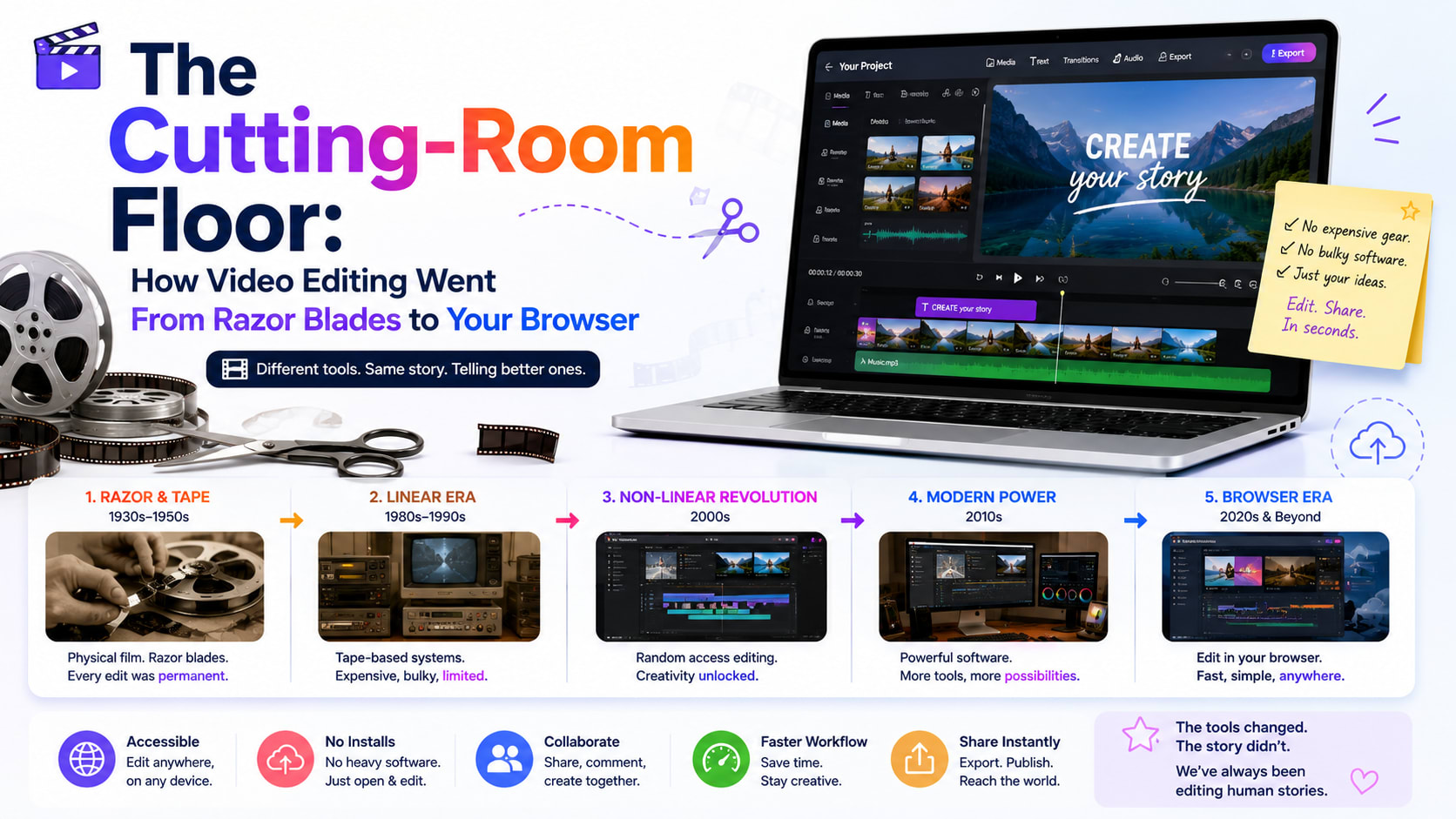
Dragging two handles to cut a clip feels like nothing — a few seconds of effort and the boring bit is gone. But that tiny act, choosing where one shot ends, is the oldest and most powerful move in all of filmmaking. For most of the last century, making that exact cut meant a pair of scissors, a smelly chemical glue, and a steady hand under a desk lamp. The phrase "left on the cutting-room floor" is not a metaphor. There really was a floor, and it really was covered in discarded film.
The story of how we got from there to a slider in a browser tab is one of the great quiet revolutions in technology — and it explains a surprising amount about why your modern trim behaves the way it does.
When editing meant literally cutting
In the earliest days of cinema, a film was a long physical ribbon of celluloid, and editing was carpentry. To shorten a scene, an editor held the strip up to a light, found the exact frame where the cut should fall, and sliced it with a blade or a guillotine-like splicer. To join two shots, they scraped the emulsion off the edge of each piece and welded them together with film cement — a fast-drying solvent glue. A finished film was thousands of these splices, each one made by hand.
This is the origin of the term "splice," still used in every editing app today, and of "the cutting-room floor," where the trimmed-out frames literally fell. It's also why the most fundamental edit is called a cut: because someone, somewhere, was cutting. When you drag the end handle inward on a video trimmer and discard the tail of a clip, you're performing the exact same operation your great-grandparents' generation did with a razor — just without the glue fumes.
The Moviola and the women who built editing
Doing this well required a machine to see the film moving, frame by frame, while you decided where to cut. In 1924 a device called the Moviola arrived — an upright contraption with a tiny viewing screen and a foot pedal that let an editor run the film back and forth, find the precise frame, and mark it. For decades it was the heartbeat of Hollywood editing rooms; the tap-tap-tap of the Moviola was the sound of a film being assembled.
Here's a piece of history that often gets skipped: in the early studio era, film editing was one of the few technical crafts open to women, and some of the most influential editors of the age were women who shaped the grammar of cinema — how long to hold a shot, when to cut to a reaction, how a sequence builds tension. Editing was understood, even then, as where a film is truly written for a second time. The cut isn't just removal; it's rhythm, meaning, and emotion. That's worth remembering even when all you're doing is topping and tailing a phone clip.
Later, flatbed editing tables known by the brand name Steenbeck let editors lay film and its separate soundtrack across horizontal plates and scrub through them smoothly. It was gentler on the film and easier on the eyes, and it ruled cutting rooms into the 1990s.
The tyranny of tape
Then came videotape, and with it a frustrating new problem. You can't physically cut and splice magnetic tape the way you can film — slicing it ruins the recording. So editing became linear: you copied the shots you wanted, in order, from one tape machine to another. Want to insert a shot in the middle of an already-assembled sequence? Too bad. Everything after it had to be re-recorded.
Linear tape editing was the dark age between the freedom of physical splicing and the freedom that was coming. It made editing a careful, planned, unforgiving process, because every change rippled forward. A whole generation of broadcast editors worked this way, building programmes shot-by-shot in real time.
The revolution: non-linear editing
The breakthrough that created modern editing was the move to non-linear editing, or NLE. Once footage could be digitized and stored on a computer's hard drives, the old constraints simply dissolved. You could jump to any moment instantly, drop a clip anywhere on a timeline, slide it, shorten it, replace it, and change your mind a hundred times — all without ever degrading or destroying the original footage. The cut became non-destructive: you weren't slicing anything, just telling the computer which frames to play and which to skip.
Systems like Avid in the late 1980s brought this to professional editing rooms and changed filmmaking forever. The freedom to experiment — to try a cut, undo it, try another — transformed not just the speed of editing but the creative possibilities. The cutting-room floor went virtual; nothing was ever truly thrown away.
This is the lineage your browser trimmer belongs to. Drag a handle and nothing is destroyed; you're describing an in-point and an out-point, exactly as a non-linear editor does, and the original file sits untouched on your device.
Why your trim sometimes starts a little early
Here's where the deep history meets a quirk you may have noticed: pick a precise start time for a fast, lossless trim, and the cut sometimes lands a fraction of a second earlier than you set. That isn't a bug — it's a direct consequence of how digital video is stored, and it's the modern echo of the old "you can only cut at a frame" rule.
Digital video doesn't keep every frame as a complete picture. To save enormous amounts of space, it stores occasional full frames — keyframes — and then, between them, only the changes from one frame to the next. Those in-between frames are meaningless on their own; they can only be decoded by starting from the keyframe before them. So a truly lossless cut, one that copies the existing data without re-processing it, can only begin at a keyframe. Ask to start between keyframes and a fast trim rounds back to the nearest one, because that's the last point where a complete picture exists.
If you need the cut exactly where you marked it, the only option is to re-encode — rebuild every frame from scratch under new rules, which lets the new clip start on any frame but takes real processing time. That's precisely the choice a good trimmer offers: a Fast mode that copies the streams instantly at keyframe boundaries with zero quality loss, and a Precise mode that re-encodes for a frame-accurate cut. The same trade-off the razor-blade editors never had to think about — because every frame of physical film was a complete picture you could cut anywhere — is now a button you choose.
It's a neat irony: the move from film to digital gave editors total freedom to rearrange footage, yet quietly reintroduced a constraint the old splicers never faced. Celluloid had no keyframes — every frame stood alone, so a blade could fall between any two of them. Compression bought us tiny files and instant streaming, but the price was that not every frame is independently cuttable anymore. Fast mode honours that reality; Precise mode pays the processing cost to escape it. Understanding which you need turns a confusing "why is my cut off?" moment into a deliberate choice.
From the studio to the browser tab
The truly remarkable part is where this all landed. Editing was once the exclusive domain of expensive machines and trained specialists in dedicated rooms. Then it moved to costly software on powerful workstations. Today, the core operation that started it all — choosing where a shot begins and ends — runs in an ordinary web page, on your phone, for free, with nothing uploaded anywhere.
That last point is its own small marvel. A browser-based video trimmer uses a complete video engine compiled to run inside the browser itself, so your footage is cut on your own device and never sent to a server. A century of editing technology — from celluloid and cement, through the Moviola and the Steenbeck, past the linear-tape dark age and the non-linear revolution — has been distilled into a tool that loads in a tab and asks nothing of you but two handles and a moment of taste.
The cut is still the thing
For all the technological upheaval, the act itself has never changed. Editing is the art of deciding what to leave out. Every viral clip, every highlight, every story that holds your attention is, at heart, a series of decisions about where to cut — what to keep and what to send to the floor, virtual or otherwise.
So the next time you trim a video down to just the good part, know that you're doing something with a deep and human history. The tools went from blades to glue to whirring machines to silent code, but the job is the same one early editors discovered over a hundred years ago: a film is made not in the shooting, but in the cutting. And now that the cutting takes nothing more than a browser and two handles, the only specialist skill left is the oldest one — knowing where the cut belongs.
