How Humans Learned to Bend Time on Film — From a Galloping Horse to the Slider on Your Screen
In 1878 Eadweard Muybridge slowed time down to win a bet about whether a galloping horse could fly. Everything since — slow-motion replays, time-lapse blooms, the speed slider in your browser — descen
How Humans Learned to Bend Time on Film — From a Galloping Horse to the Slider on Your Screen
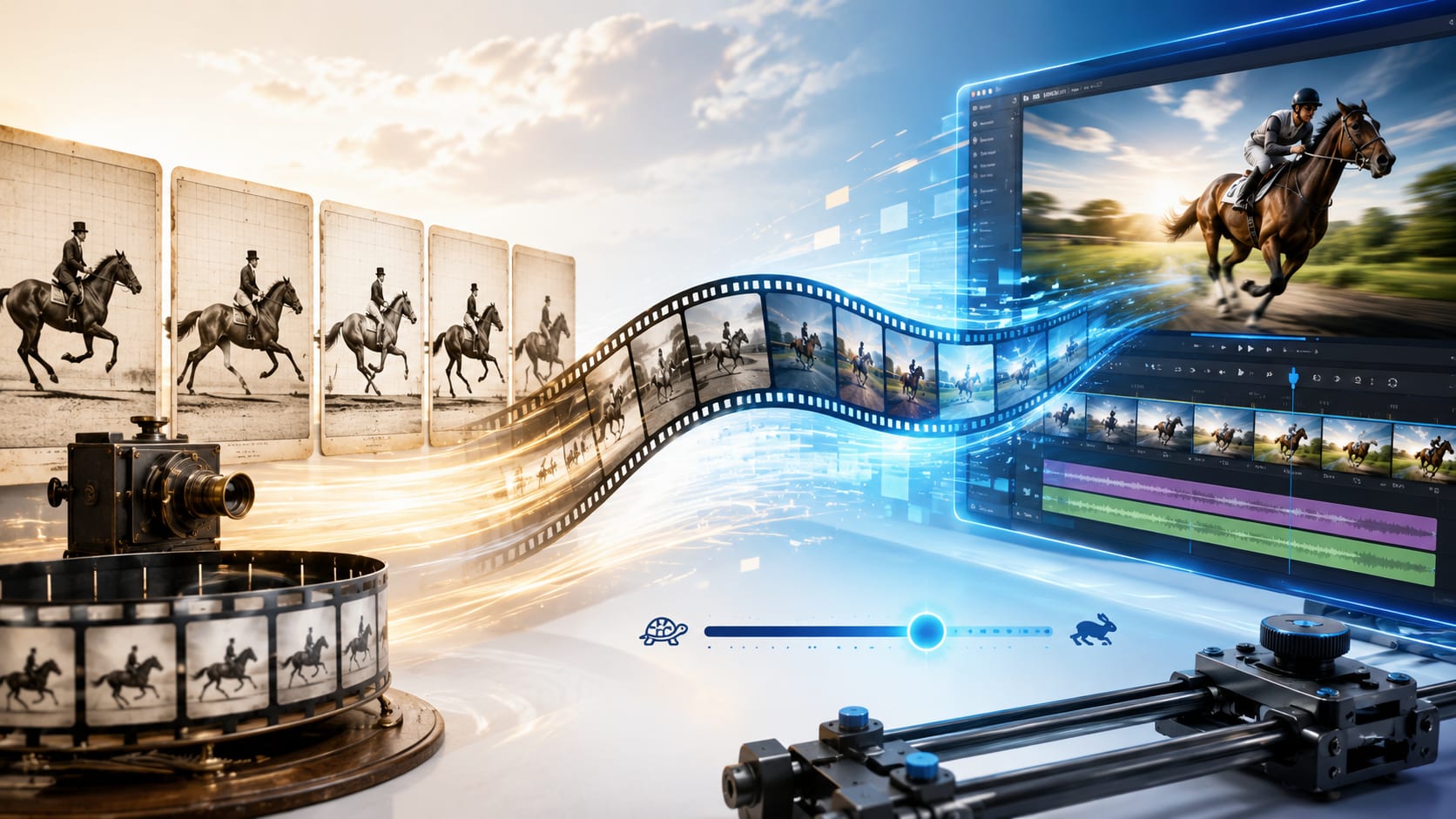
In 1872, a railroad tycoon named Leland Stanford made a bet that would, almost by accident, change how the human eye sees the world. The wager was about a horse. Specifically, Stanford insisted that a galloping horse lifts all four hooves off the ground at once — a moment of pure flight invisible to the naked eye because it happens too fast. Painters of the era never showed it; they drew horses in the "rocking horse" pose, front legs stretched forward, back legs stretched behind, like a child's toy. Nobody could prove what really happened in that blur of motion, because the human visual system simply cannot freeze a quarter-second of a galloping animal.
Stanford hired a brilliant, eccentric photographer named Eadweard Muybridge to settle it. It took Muybridge six years and a custom rig of cameras with electrically-triggered shutters lined up along a track. In 1878 he finally captured it: a sequence of frozen frames showing the horse Sallie Gardner mid-stride. Stanford was right — all four hooves leave the ground, but not when the legs are splayed out. They lift when the legs are tucked underneath the body, a pose no painter had ever imagined. The bet was won, but the real prize was something nobody had set out to find. Muybridge had built a machine that could slow time down enough for a human to look at it.
That is the whole story of speed-changing video, compressed into one anecdote. Everything since — the slow-motion replay that shows a foot grazing the line, the time-lapse of a flower unfurling in ten seconds, the bullet-dodging shot in The Matrix, the video speed changer sitting in your browser tab right now — is a descendant of one man trying to see whether a horse could fly.
The frame is the atom of time
To understand how we bend time, you have to understand the one fact that makes film possible at all: motion in video is an illusion stitched together from still photographs. A movie is just a stack of photographs shown fast enough that your brain refuses to see the gaps. Shoot 24 of those photographs every second, play them back at 24 every second, and the world looks normal. The frame is the atom of recorded time — the smallest indivisible slice.
Once you accept that, the trick reveals itself. There is no rule that says you must play the frames back at the same rate you captured them. What if you captured 240 photographs every second but played them back at 24? Then a single second of real life would take ten seconds to watch. You would have slow motion — not blurry, dreamy "slow" but crisp, detailed slow, every droplet of a splash hanging in the air with the clarity Muybridge gave the horse. And what if you did the opposite: captured one photograph every ten seconds, then played them at 24 per second? A whole day of clouds would scud across the sky in moments. That is time-lapse. Speeding up and slowing down are not two different tricks. They are the same single idea — a mismatch between the capture rate and the playback rate — pointed in opposite directions.
The early film world had wonderfully physical names for this. Cameras were hand-cranked, so to get slow motion you turned the crank faster than normal, packing more frames into each second of real time. They called it overcranking. To speed the world up, you cranked slower — undercranking. The terms survive in professional film sets a century after the cranks themselves disappeared, the way sailors still talk about "cabling" speeds. Overcrank for slow, undercrank for fast. A cameraman who wanted a comedic chase scene — think the frantic, jerky scrambles of silent-era slapstick — would simply undercrank, and the actors would appear to scuttle about at double speed when the film was projected at the standard rate.
Slowing down: the limit nobody warns you about
Here is the part that trips up almost everyone the first time they slow a clip down on a phone or a website. They take an ordinary video — say, their kid scoring a goal, shot at the normal 30 frames per second — drag the speed down to a quarter, and expect the buttery slow motion they've seen on television. Instead they get something that stutters and judders, each frame held visibly on screen like a slideshow.
The reason is the most important truth in this entire subject, and it goes back to Muybridge's track of cameras. You can only slow down what you actually captured. If you filmed at 30 frames a second and you stretch that footage to play four times slower, the software has only 30 real photographs to spread across what now feels like four seconds. It has to show each frame roughly four times as long. The in-between moments — the parts that would make the motion smooth — were never photographed. They don't exist. No amount of cleverness can invent detail that the camera never recorded.
This is why genuinely gorgeous slow motion has to be planned before you press record. A camera that shoots 240 frames per second is capturing eight times as many slices of each second as a normal 30 fps camera. Slow that down to normal playback and every frame is real, every moment is there, and the motion glides. Sports broadcasters use cameras that capture thousands of frames per second for those replays where you can count the rotations on a spinning ball. The slowness was baked in at the moment of capture. Stretching footage afterward in software is a fundamentally different act — you are not revealing hidden moments, you are simply lingering on the ones you have.
Modern software does fight back against the judder with a technique called frame interpolation: it studies two consecutive frames and synthesizes plausible "tween" frames to fill the gaps, guessing where the pixels were headed. When it works it's near-magical; when it fails you get smeared, melting artifacts around fast or complex motion. But interpolation is an educated guess, not a recording. The honest rule, the one worth tattooing on the inside of every filmmaker's eyelids, is the one Muybridge proved: if you want to see it slowly, you have to capture it quickly first.
Speeding up: where time-lapse becomes its own art form
Going the other direction has its own deep history and its own quiet beauty. The first time-lapse films appeared at the dawn of cinema, around 1897, when a pioneer named Georges Méliès reportedly stumbled onto frame tricks when his camera jammed and restarted, making a bus appear to transform into a hearse. Within a couple of decades, botanists were using time-lapse to reveal what no human had ever watched continuously: the slow choreography of a plant growing, leaves turning to follow the sun, a bud cracking open into a bloom. Compress hours into seconds and suddenly plants look like animals — reaching, twisting, hunting the light. The technique didn't just record nature faster; it revealed behavior that was always happening at a speed too slow for human patience to perceive.
Speeding up is mathematically the friendlier direction, and there's a comforting reason why. When you slow footage down you run out of frames and have to fake them. When you speed footage up you have a surplus — too many frames for the shortened duration — so the software simply discards the extras and keeps a clean subset. There's nothing to invent. That's why a sped-up clip almost always looks crisp while a slowed-down clip risks stuttering. You're throwing information away, and throwing away is always cleaner than making up.
This is the everyday workhorse of modern content. The cooking video that condenses a two-hour braise into fifteen seconds. The construction time-lapse where a building rises like a mushroom. The "study with me" video played at triple speed. The dashcam footage skimmed at 8× to find the interesting moment. Every one of these is undercranking reborn for the internet age — the same instinct that made silent comedians scurry, now applied to making the slow parts of life watchable.
The chipmunk problem, and the maths that solved it
There's one wrinkle that pure film never had to deal with, because early film was silent: sound. The moment you add an audio track, speeding video up or slowing it down creates an immediate, comic problem.
Think about what sound physically is — vibrations in air, captured as a wave that wiggles up and down a certain number of times per second. That rate of wiggling is pitch. A deep voice wiggles slowly; a high voice wiggles fast. Now play that recording at double speed. Every wiggle arrives twice as fast, the pitch doubles, and a grown adult suddenly sounds like a chipmunk who's been at the helium. Slow it down and everyone sounds like a demon in a horror film. For decades this was simply the cost of changing speed — the squeaky fast-forward and the groaning slow-down were sounds an entire generation associated with rewinding a cassette tape.
The fix is genuinely clever, and it's running quietly inside the video speed changer above whenever you leave the audio enabled. The technique is called time-stretching, and the trick is to separate two things that naïve speed-changing fuses together: how long a sound lasts and how high it is. The software chops the audio into tiny overlapping grains, then repackages them into the new, shorter (or longer) duration — overlapping and cross-fading the grains so the pitch of each one is untouched, only their spacing in time changes. The result is audio that genuinely plays faster or slower while voices and music keep their natural pitch. No chipmunks. No demons. Just a presenter who happens to talk a little quicker.
Under the hood of professional and open-source tools, this is handled by a filter often called atempo. It has a quirk worth knowing about: it can only stretch within a limited range in a single pass — roughly half-speed to double-speed. To go beyond that — say, to 4× — the software chains the effect: double it, then double it again, each pass staying inside the safe zone, the way you'd climb a tall wall with two short ladders instead of one impossibly long one. You never see this happening, but it's why a well-built tool can take you all the way from a quarter speed to quadruple speed without the audio collapsing into noise.
Why "just change the speed" became a thing you do in a browser
For most of this history, bending time was the exclusive territory of people with expensive equipment — Muybridge's bank of cameras, the high-speed rigs of sports broadcasters, the edit suites of film studios. The democratization happened in two waves. First, digital video turned frames from physical strips of celluloid into numbers in a file, which meant rearranging them no longer required a darkroom — just maths. Second, and more recently, that maths moved into the web browser itself.
The tool above runs entirely on your own device. There's no upload, no server crunching your footage in some distant data center, no watermark stamped across the result, no queue. The engine behind it is a full video-processing toolkit compiled to run inside the browser's sandbox, the same family of software that powers professional editing under the hood. When you drag the slider, your computer is doing the re-timing locally — reading the frames, deciding which to keep or how long to hold them, time-stretching the audio so nobody squeaks, and re-encoding the result. Your video never leaves your machine. For something as personal as home footage, that privacy isn't a footnote; it's the whole point.
A few practical notes that flow directly from everything above. If you want smooth slow motion, the single best thing you can do is film at a high frame rate to begin with — slowing down ordinary footage will always have a ceiling. If you're speeding a clip up, you have far more freedom, because you're discarding frames rather than inventing them, so don't be shy about pushing it. If you only need part of the clip, trim it first so you're not re-encoding footage you'll never use — it's faster and the file stays smaller. And keep "preserve audio" on unless you specifically want silence; the time-stretching that prevents the chipmunk effect costs you nothing.
The horse, still galloping
There's a pleasing symmetry in all of this. Muybridge slowed time down to win a bet about whether a horse could fly. A hundred and fifty years later, the same fundamental idea — that captured frames and played-back frames don't have to march in lockstep — sits behind a slider you can drag with your thumb to make your dog's zoomies look majestic in slow motion or compress a sunset into a few breathing seconds.
What hasn't changed is the reason any of it is interesting. We bend time on film for the same reason Stanford and Muybridge did: because there are things happening in the world at speeds the human eye was never built to see. Some things are too fast — the splash, the wingbeat, the foot crossing the line. Some are too slow — the bloom opening, the shadow crawling across a wall, the city changing over a year. Speeding up and slowing down are simply the two telescopes we've built to look at time the way astronomers look at distance: by changing the scale until the invisible becomes obvious.
The next time you slow a clip to a crawl and notice some small detail you'd never have caught at full speed — the exact instant a smile starts, the way water beads before it falls — you're doing precisely what that bank of cameras did beside a racetrack in 1878. You're catching the horse in flight. Go ahead and bend a little time of your own; the only equipment you need is the browser you already have open.
