The Hidden Passenger: What Your Video Files Secretly Remember
When a fugitive's photo gave away his location through invisible GPS data, the world got a lesson in metadata — the silent layer riding inside every media file. What your videos quietly record about w
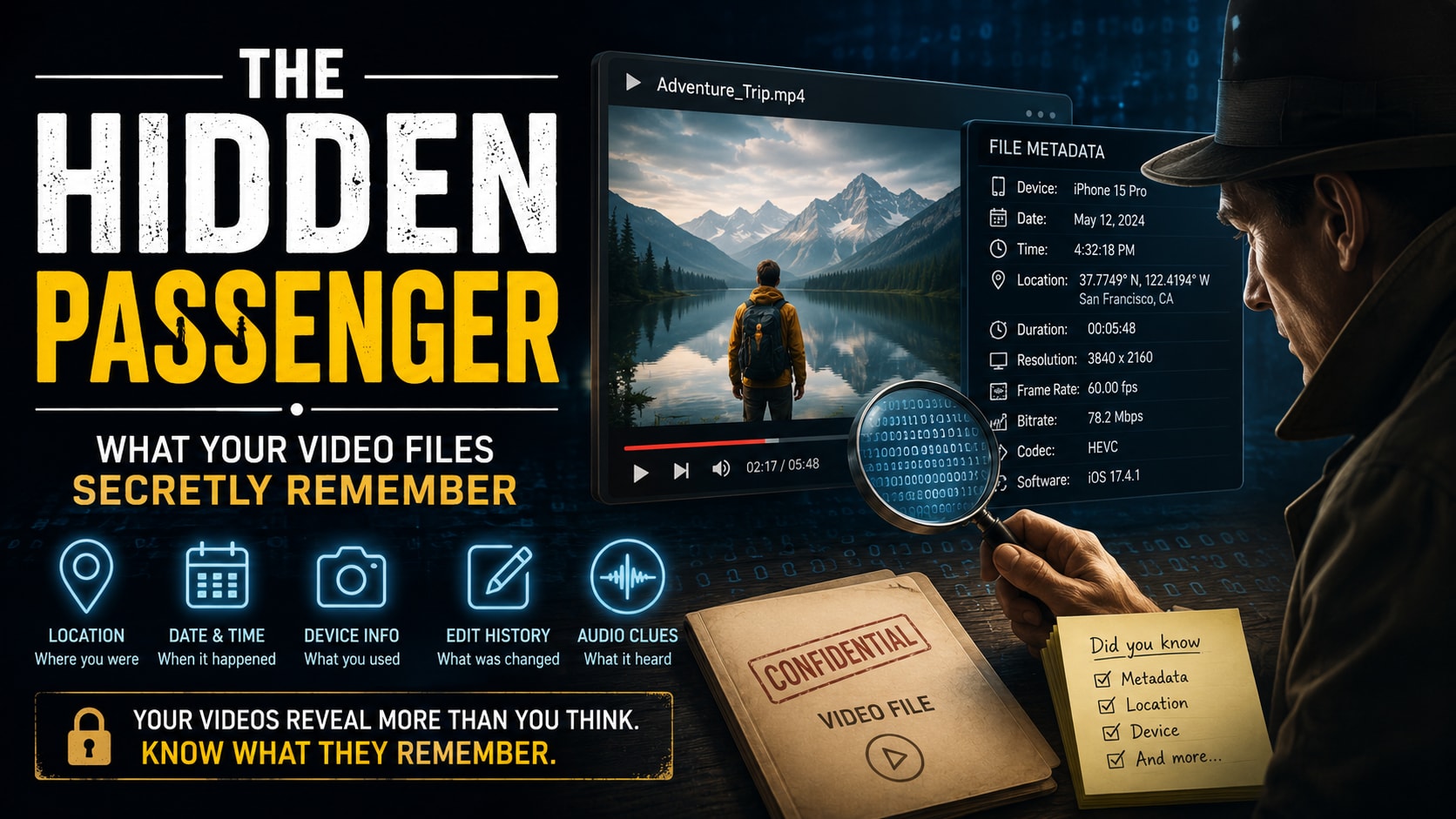
The Hidden Passenger: What Your Video Files Secretly Remember
In December 2012, the software millionaire John McAfee was on the run. Wanted for questioning by authorities in Belize, he had slipped across borders and was hiding out, taunting the world from a blog while reporters tried to find him. Then two journalists from Vice magazine, who had managed to meet him, posted a triumphant photo with the caption "We are with John McAfee right now, suckers." It was meant to be a scoop. Instead it was a catastrophe — because nobody had thought about the hidden passenger riding inside the image file.
The photo had been taken on an iPhone, and like most phone photos, it carried a small packet of invisible information baked into the file: among other things, the exact GPS coordinates of where the shutter had been pressed. Within hours, people online had pulled those coordinates out of the file and pinpointed a location in Guatemala. The fugitive who had been so careful to stay hidden had been given away not by anything in the picture, but by a string of numbers nobody could see. That packet of invisible information has a name. It's called metadata — and your videos are full of it.
This is the strange double life of every media file you create. There's the obvious part: the picture, the sound, the thing you actually want to share. And then there's the second, silent layer — data about the data — that quietly records circumstances you never chose to broadcast. A video metadata viewer exists precisely to drag that hidden layer into the light, so you can see what your files are saying behind your back before you hand them to the world.
Data about data
The word sounds dry, but metadata is one of the most quietly powerful ideas in the digital age. The clearest way to understand it is the old library card catalogue. The book is the data. The little card describing the book — its author, its publication date, where it sits on the shelf — is the metadata. You can learn an enormous amount about a book without ever opening it, just from the card.
The same is true of a video. Without ever watching a single frame, the metadata can tell a remarkably complete story: when it was filmed, down to the second; what device shot it, often the precise make and model; what software last touched it; how long it runs; and, if location services were on, where on Earth the camera was standing. None of that is the content of the video. All of it travels with the video anyway, stitched invisibly into the file.
How powerful is that second layer on its own? Powerful enough that intelligence agencies treat it as a target in itself. Michael Hayden, the former head of both the NSA and the CIA, once said plainly in a public debate: "We kill people based on metadata." He wasn't talking about reading the contents of anyone's messages — he was talking about the patterns the surrounding data reveals: who contacted whom, from where, and when. The lesson scales all the way down to a holiday clip on your phone. The content is only half of what you're sharing. The card in the catalogue is the other half.
The files that talked too much
Once you start looking, the history of metadata leaks reads like a comedy of unintended confessions.
In 2003, the British government published a dossier making the case for the war in Iraq. It was distributed, fatefully, as a Microsoft Word document. Word, like most software, quietly records a revision history inside its files — a metadata trail of who edited the document and when. A researcher downloaded the file, opened up that hidden trail, and found the names of the officials who had worked on it. Worse, comparison of the text revealed that large sections had been lifted, typos and all, from a graduate student's thesis published years earlier. The "intelligence dossier" had a paper trail it never meant to carry, and metadata is what exposed it.
A decade later, an artist named Owen Mundy turned the whole phenomenon into a sly piece of public art. He built a project called "I Know Where Your Cat Lives," which gathered up cat photos that people had posted publicly online and plotted them on a world map — using the GPS coordinates buried in each image's metadata. Millions of cute, innocuous cat pictures, each one quietly broadcasting the latitude and longitude of someone's living room. The point was gentle but pointed: people were geotagging their exact home addresses without the faintest idea they were doing it.
That's the unsettling charm of the hidden passenger. It almost never causes a problem — until the one time it does, and by then the file is already out of your hands.
What a video specifically remembers
Photos get most of the attention in these stories, but video files are, if anything, richer record-keepers, because a video is a more complicated object with more to describe. When you open one up in a viewer, the things you find fall into a few neat groups, and understanding them turns a wall of jargon into a genuinely useful X-ray of your file.
First there's the container, which is the box itself — MP4, MOV, WebM, MKV. This is the format named by the file extension, and it's a wrapper, nothing more. It's the cardboard carton, not the thing inside.
Inside that box sits the codec, and this is the part that trips most people up. The codec is the method used to squeeze the video and audio down to a shareable size — names like H.264, H.265 (also called HEVC), VP9, and AV1 for the picture, and AAC or Opus for the sound. Here's the crucial, widely-misunderstood truth: the container and the codec are not the same thing. An ".mp4" file is just a box that can hold H.264 video, or H.265, or several other things entirely. This is why two files that both end in ".mp4" can behave completely differently — one plays everywhere, the other refuses to open on an older device. Same box, different contents. A metadata viewer is the quickest way to settle the mystery, because it shows you both the box and what's actually inside it.
Then there are the technical vitals: the resolution and frame rate, and the bitrate — the amount of data spent per second of footage. Bitrate is where quality and file size are really decided, and it's quietly revealing to see how it's split. In almost every video, the picture devours the overwhelming majority of the data — frequently well over ninety-five percent — while the entire soundtrack rides along on a tiny sliver. Seeing that breakdown for the first time reframes how you think about what's actually "heavy" in a video.
And finally there are the tags — the McAfee layer. The creation date. The encoder or app that produced the file. On phone footage, often the device's make and model. And, when location services were enabled at the time of filming, the GPS coordinates. These are the details that have nothing to do with how the video looks and everything to do with your privacy. They're the reason it's genuinely worth glancing at a file's metadata before you post it somewhere public.
The pleasure of looking inside
There's a satisfying, almost forensic pleasure in inspecting a file this way, quite apart from the privacy angle. You can finally answer the questions that nag at anyone who works with video: Why won't this clip play on my TV? (Probably an unsupported codec, which the viewer names instantly.) Is this actually 4K, or did someone upscale a smaller file and relabel it? (The real resolution doesn't lie.) Why is this two-minute clip half a gigabyte? (Check the bitrate.) What phone shot this? (Often right there in the tags.)
You can also stumble onto the genuinely mind-bending numbers hiding in plain sight. A video viewer can compute, from the raw dimensions and frame rate, how enormous a clip would be if it were stored completely uncompressed — every pixel of every frame written out in full. The answer is routinely hundreds of times larger than the actual file. That ratio is a quiet monument to the codec's invisible labour: the reason a two-hour film fits on a phone at all is that the codec is performing a feat of compression so aggressive it borders on the magical, throwing away the vast majority of the raw data while fooling your eye into seeing all of it.
None of this requires uploading your video anywhere, and for metadata in particular that matters a great deal. The whole point of inspecting the hidden layer is privacy — it would be self-defeating to learn what secrets your file carries by first sending those secrets to a stranger's server. A good online video metadata viewer reads everything locally, in your own browser, so the file and its hidden passenger never leave your device.
Know what you're carrying
The McAfee photo, the dossier with the telltale revision log, the cat pictures mapped to people's front doors — they all share one lesson, and it isn't "be paranoid." It's simpler than that: know what you're carrying. Every file you make is a traveller with luggage you didn't pack, and most of the time that luggage is harmless. But you can't make a sensible decision about sharing something if you can't see what's inside it.
So the next time you're about to send a clip to the world — a property listing, a marketplace video, a post from somewhere you'd rather not pin to a map — take ten seconds to look under the hood first. Open it up and read its metadata, see exactly what it remembers about when, where, and how it was made, and then decide, with open eyes, what you want to share. The hidden passenger is a lot less dangerous once you've actually met it.
