Everything Outside the Frame: The Quiet Art of Deciding What You Don't Show
A frame is defined less by what's in it than by what you left out. From the 1797 origin of the rule of thirds to the close-ups that once terrified audiences and the 'pan and scan' butchery of widescre
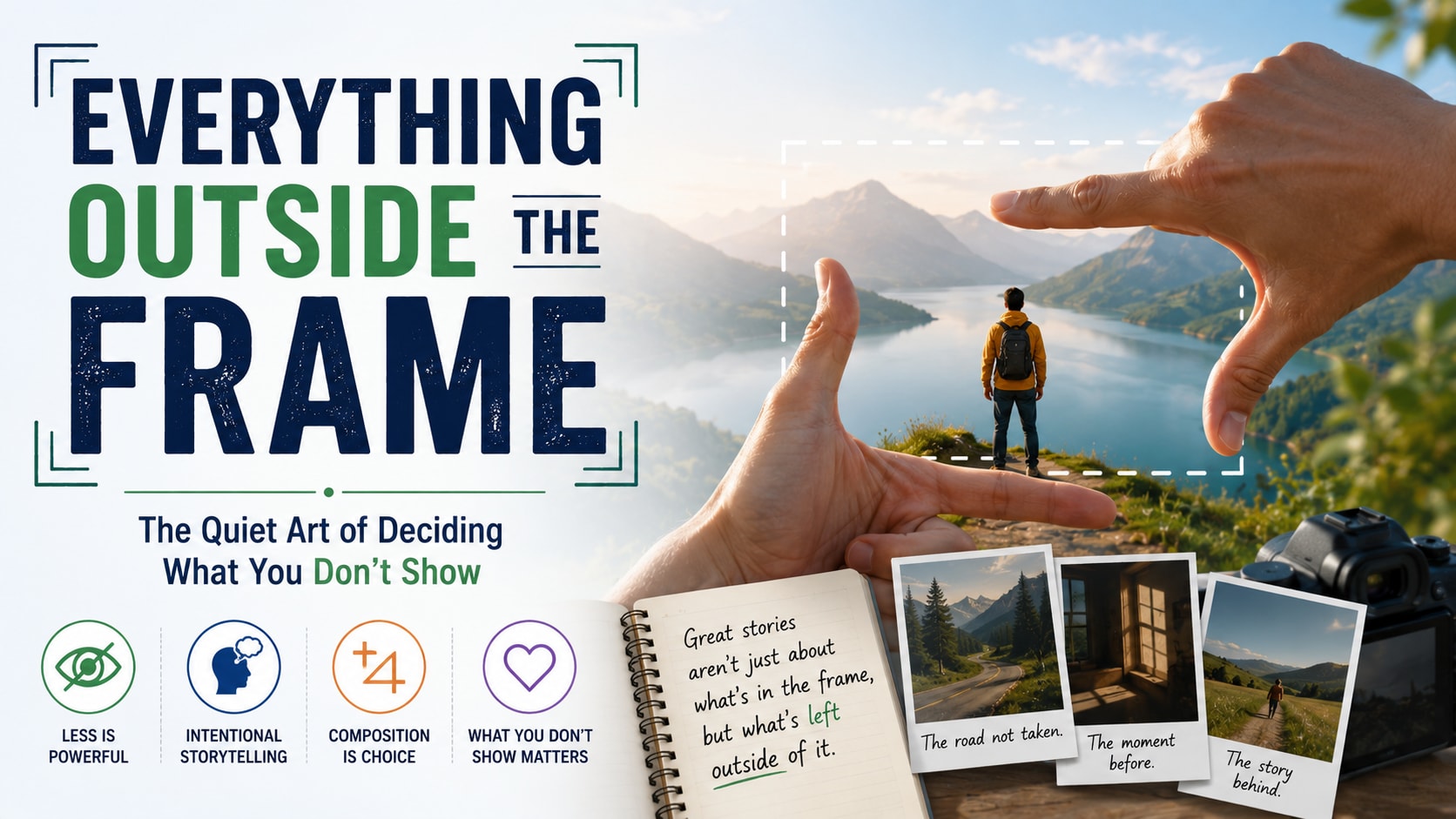
Everything Outside the Frame: The Quiet Art of Deciding What You Don't Show
There's an old piece of advice passed around photography and film schools that sounds like a riddle the first time you hear it: a picture is defined less by what's in it than by what you left out. It feels backwards. Surely a shot is about the thing you point the camera at? But spend any time actually framing images and the riddle resolves into something obvious and a little profound. Every frame has four edges, and those edges are decisions. The moment you draw a rectangle around a slice of the world, you are not just choosing what to include — you are banishing everything else into a void the viewer will never see and, crucially, will never know was there.
That act of drawing the rectangle has a name when you do it after the fact: cropping. And it is one of the most consequential things you can do to an image or a video, far more powerful than its humble reputation suggests. When you drag a box over a clip in a video cropper and keep only the middle of the frame, you're not performing a minor technical tidy-up. You're doing the same thing every cinematographer, painter, and photographer has done since the idea of the frame was invented: deciding where the world stops.
The frame is younger than you think
We treat the rectangular frame as if it were a law of nature, but it's an invention, and a fairly arbitrary one. When you look at the actual world, there is no frame. Your vision fades softly at the edges into a vague periphery; there are no hard borders, no neat rectangle. The framed image is a human imposition — a window we agreed to cut into the wall of reality.
Painters wrestled with this for centuries, and out of that wrestling came a piece of advice so durable it's now baked into the gridlines of nearly every phone camera: the rule of thirds. The phrase itself was coined remarkably early. In 1797 an English engraver and writer named John Thomas Smith, writing about landscape painting, suggested dividing a composition into thirds and placing the important elements along those lines rather than dead centre. He was formalising something painters had felt intuitively for ages — that a subject parked exactly in the middle tends to feel static and lifeless, while one set a third of the way across creates a pleasing tension, a sense of space for the eye to move into.
Two centuries later, that same grid shows up as faint lines on your screen and, not coincidentally, as the gridlines overlaid on a crop box. It's the single most useful thing to know when you reframe a video: drop your subject onto one of those third-lines rather than the centre, and an ordinary shot suddenly looks composed. Cropping is often the only chance you get to apply the rule of thirds after filming — to rescue a clip where you stood too far back or framed your subject dead-centre, by trimming the frame down to a stronger composition.
When the close-up terrified people
If cropping is the art of getting closer by cutting away the surroundings, then its most dramatic ancestor is the close-up — and the close-up's arrival was genuinely shocking. In the very earliest days of cinema, films were shot like filmed theatre: the camera sat back at a polite distance, showing actors head-to-toe as if you were in the stalls watching a stage. The frame contained the whole body and the whole scene, because that's what an audience expected to see.
Then filmmakers began moving in. When the first big close-ups of a human face filled the screen, accounts from the era describe audiences as unsettled, even alarmed — a giant disembodied head, a face with no body, magnified to monstrous size. Where had the rest of the person gone? It violated the unspoken contract that a picture shows you a whole thing. But directors quickly realised that this violation was the entire point. By cropping the world down to a single face, they could force the audience to read an emotion, to lean in, to feel intimacy or dread. The close-up didn't show more; it showed less, and in showing less it showed something deeper. The power came from everything that had been pushed out of frame.
This is the secret hiding inside the unassuming crop tool. Tightening the frame is not subtraction in the way it looks. Cut away the cluttered background, the distracting bystander, the dead space above someone's head, and what remains doesn't just survive — it intensifies. The viewer's attention has nowhere else to go.
The suspense of what you can't see
The masters of cinema understood that the edge of the frame is not a wall but a threshold, and that the unseen is often more potent than the seen. Alfred Hitchcock built entire careers' worth of dread out of this principle. A character walks toward a door; we, the audience, can see the danger lurking just out of their sightline — or sometimes we can't, and the not-seeing is worse. The frame becomes a source of anxiety precisely because we know the world continues beyond it and we cannot check what's there.
Horror films live on this. The monster is scariest when it's mostly off-screen, implied at the edge, a shape half-cut by the frame line. The instant you show the whole creature in full, lit and centred, the fear drains away. What the frame excludes does the heavy lifting. This is why thoughtful cropping can change the entire emotional register of a clip: keep a sliver of something at the edge and you create unease or curiosity; centre it fully and you resolve the tension into mere information.
The crime of "panning and scanning"
For all its creative power, cropping has a dark chapter, and it's one of the great quiet controversies of home video. When widescreen cinema films were brought to the older, boxier television sets of the twentieth century, they didn't fit. A sweeping widescreen image is far wider than a square-ish TV screen. Broadcasters and video distributors had two choices: show the whole wide image with black bars above and below it (letterboxing), which audiences of the time found baffling and disliked — why is part of my screen black? — or crop the sides off to fill the screen.
They mostly chose to crop, and the technique was called pan and scan. A technician would decide, shot by shot, which portion of the widescreen frame to keep, sliding an invisible window across the original image to follow the "important" part — and sometimes literally panning that window mid-shot to catch a character who'd been cut out of the trimmed frame. The results could be absurd. A carefully composed two-person conversation, framed by the director with both faces at opposite edges of a wide screen, would become a frame showing only empty wall in the middle, with the camera awkwardly jerking back and forth between the speakers. As much as half of the original picture could simply vanish.
Directors were furious. Some of the most fastidious filmmakers in history fought it openly, insisting their films be shown letterboxed, with the full frame intact, even if audiences grumbled about the black bars. The phrase "This film has been modified from its original version. It has been formatted to fit this screen" — that little apologetic disclaimer — was the fingerprint of pan and scan, an admission that you were not seeing what the director composed. It took the eventual triumph of widescreen televisions and home formats for letterboxing to win and pan-and-scan to fade into history as a cautionary tale: a reminder that careless cropping can mutilate as easily as it can improve.
Cropping with intention
The lesson of pan and scan isn't that cropping is bad — it's that cropping is powerful, and power cuts both ways. Done thoughtlessly, it severs the part of the image that mattered. Done with intention, it's one of the most useful reframing tools you have, and today most of us need it constantly for an entirely modern reason: the same clip has to live on screens of wildly different shapes. A landscape video shot on a camera needs to become a square for one feed, a tall slot for a Stories-style format, a wide banner for another. Each of those is a crop — a deliberate decision about which third of the frame carries the meaning and which edges can be sacrificed.
A few principles make those decisions better. Keep your subject on a third-line, not dead centre, and a reframed clip instantly looks more professional. Watch the headroom — the gap above a person's head — because amateur footage almost always has too much of it, and trimming it down is the single fastest way to make a shot feel composed. When you crop a wide video into a tall one, remember the pan-and-scan trap: make sure the thing that matters is actually inside your new, narrower box, not stranded at an edge you're about to cut away. And because cropping keeps the original pixels at their original size rather than blowing them up, you lose nothing in sharpness — you're choosing a region, not zooming into a blur.
The wonderful thing about doing this on your own footage is that it's reversible and risk-free in a way the pan-and-scan technicians of the past could only dream of. You can drag the box, watch the composition change in real time, try a square, try a tall frame, and see exactly what each choice does before you commit. The frame stops being a fixed window and becomes a creative variable you control.
So the next time you trim the edges off a clip, give a thought to everything you're pushing out of view. You're standing in a long tradition — Smith dividing his landscapes into thirds, the first directors daring to fill the screen with a single face, Hitchcock hiding terror just past the frame line. Framing has always been the art of exclusion, and cropping is simply that art, applied after the fact, with the luxury of changing your mind. Reframe a video and see what a difference an edge makes — sometimes the best thing you can add to a shot is less of it.
