Who Invented the To-Do List? From Da Vinci to the $25,000 Productivity Tip
A consultant once gave a steel tycoon a to-do list method and got paid $25,000 for it. From Leonardo da Vinci's notebooks to the Eisenhower Matrix and GTD, here's the surprising history — and science
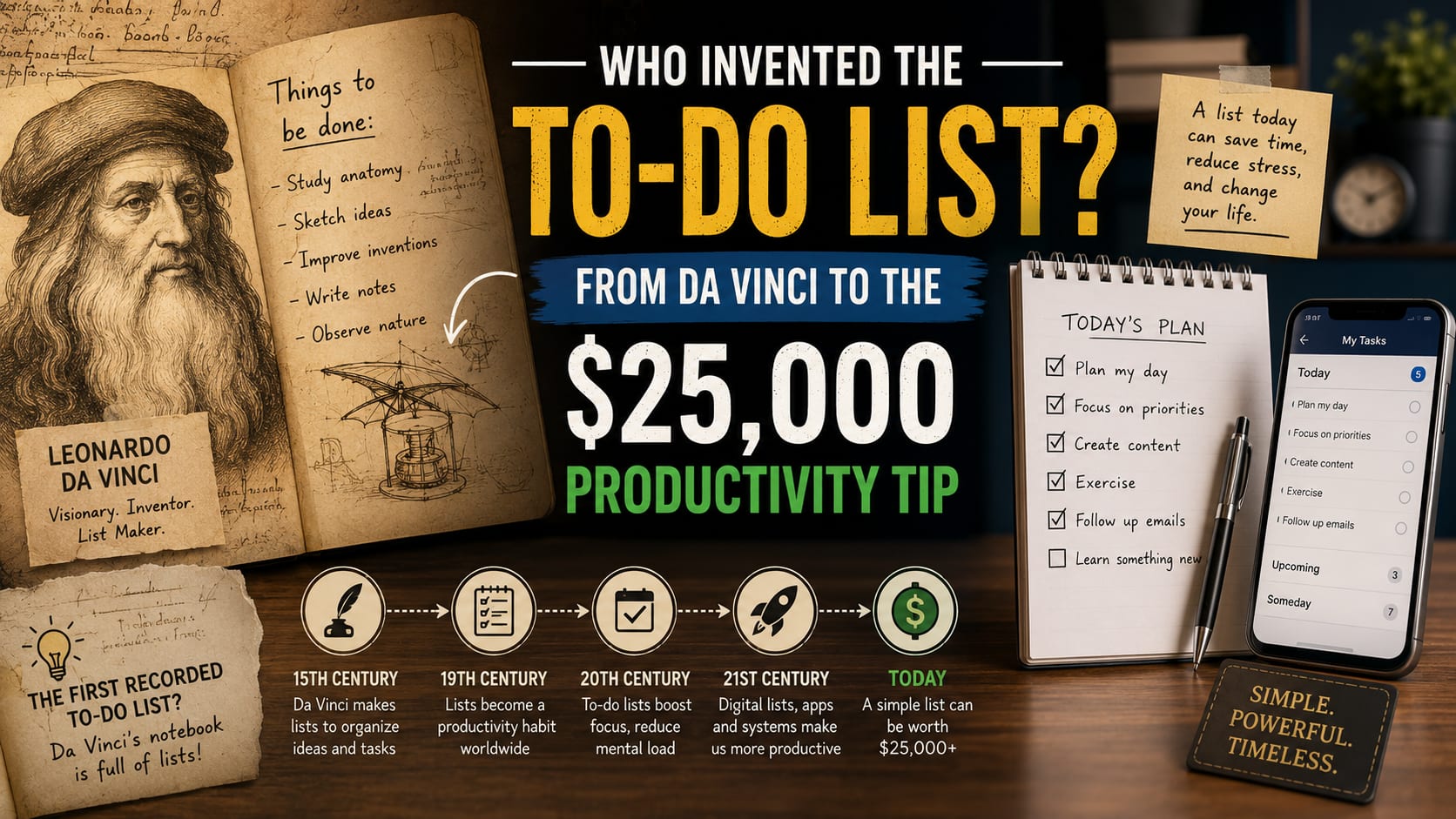
In 1918, a consultant named Ivy Lee made a steel tycoon an unusual offer. He'd share a single productivity idea, and the executive could pay him whatever he thought it was worth after trying it for a few weeks. The idea took about fifteen minutes to explain. A few weeks later, the tycoon — Charles M. Schwab, who ran Bethlehem Steel — reportedly mailed Lee a cheque for $25,000. In today's money that's roughly half a million dollars, for what was, in essence, a to-do list.
We treat the to-do list as something trivial, a scrap of paper or a quick note on a phone. But it has a long, surprisingly rich history, and the best minds of the last five centuries kept reinventing it. Once you know where it came from, that little checklist starts to look less like a chore and more like one of humanity's most reliable thinking tools.
Lists older than the office
Long before productivity was an industry, people were scribbling things they needed to do. The most charming early example belongs to Leonardo da Vinci. His notebooks are full of to-do lists — not of errands, but of things he wanted to learn. Historians poring over his pages have found entries that read like a Renaissance curiosity engine: work out the measurement of Milan and its suburbs, get a master of arithmetic to show you how to square a triangle, ask a particular merchant how the people of Flanders manage to walk on ice. One famous line simply instructs himself to "describe the tongue of the woodpecker."
These weren't tidy productivity systems. They were the overflow of a restless mind onto paper — the same impulse that makes you jot "call the dentist" before you forget. The form is five hundred years old. We just gave it an app.
Benjamin Franklin's daily question
By the 18th century, Benjamin Franklin had turned the list into something closer to a personal operating system. In his autobiography he describes a daily schedule built around two questions. Each morning he asked himself, "What good shall I do this day?" and each evening, "What good have I done today?" Between them sat blocks for work, meals, and rest.
He paired this with his famous chart of thirteen virtues — temperance, order, industry and the rest — tracking his slips against each one in a little grid. It was part to-do list, part habit tracker, part diary. Franklin understood something we keep rediscovering: a list isn't only about remembering tasks, it's about deciding, on purpose, what your day is for.
The $25,000 to-do list
Which brings us back to Ivy Lee and that astonishing fee. The method he gave Charles Schwab was almost insultingly simple, and it still holds up:
- At the end of each day, write down the six most important things you need to accomplish tomorrow — no more than six.
- Put them in order of true importance.
- The next day, start at the top and work down. Only move to the second task when the first is finished.
- Anything unfinished rolls over to a fresh list of six the following day.
The genius isn't the writing-down; it's the brutal limit and the forced ranking. Six items means you can't hide a hundred vague intentions in a list nobody could ever complete. Doing them strictly in order means you protect your best energy for what matters most, instead of frittering it on whatever shouts loudest. The Ivy Lee Method is still one of the most recommended ways to plan a day, more than a century later.
Urgent versus important
The next great leap was learning to tell two things apart that feel identical in the moment: urgency and importance. The idea is usually traced to Dwight D. Eisenhower, the general turned US president, who is often quoted as saying that his problems came in two kinds — the urgent and the important — and that the urgent were rarely important while the important were rarely urgent.
Decades later, the author Stephen Covey turned that observation into the grid now known as the Eisenhower Matrix: a square split into four boxes by two questions — is it urgent, and is it important? Important-and-urgent gets done now. Important-but-not-urgent (planning, health, relationships) is where the real life happens and where we chronically under-invest. Urgent-but-not-important is the trap — other people's fires. And the last box, neither urgent nor important, is just noise. A good to-do list quietly nudges you to spend more time in that second box.
Eat the frog
If the Eisenhower Matrix is about choosing, "eat the frog" is about starting. The phrase is usually pinned on Mark Twain — though, fittingly for the internet age, the attribution is shaky — and the idea is this: if the first thing you do each morning is eat a live frog, you can go through the day knowing the worst is behind you.
Translated into task management by the author Brian Tracy, the "frog" is your biggest, most important, most dreaded task. Do it first, before email, before the easy wins, before your willpower drains away. Most of us instinctively clear the small, satisfying items first and leave the frog sitting on the list for days, radiating dread. Tackling it first flips the whole psychology of the day.
The modern art of doing less
Somewhere along the way, to-do lists got out of hand. Apps let us hoard hundreds of tasks, and a list that never ends stops motivating and starts oppressing. The best modern methods are really about restraint.
The 1-3-5 rule is a neat example: on any given day, plan to finish one big thing, three medium things, and five small things. That's it — nine items, sized honestly. Similarly, many people swear by choosing two or three "Most Important Tasks" each morning and treating everything else as optional. The common thread, from Ivy Lee to today, is that a useful list is a short one. Capturing everything is fine; trying to do everything is not.
Getting it all out of your head
The most influential modern system, Getting Things Done — usually shortened to GTD — comes from David Allen's 2001 book of the same name. Its core promise is psychological. Allen argues that your mind is "for having ideas, not holding them," and that unfinished commitments rattling around in your head create a constant background stress. His fix is to capture absolutely everything into a trusted external system, so your brain can finally let go. He calls the resulting calm focus "mind like water."
You don't have to adopt the whole elaborate method to feel the effect. Even a plain list, if you actually trust it, does the essential job: it becomes the place where your commitments live so your head doesn't have to. That's the whole point of keeping a to-do list outside your head — not to remember more, but to be allowed to forget.
Why writing it down actually works
There's solid cognitive science under all of this. Back in 1956, the psychologist George Miller published one of the most cited papers in the field, proposing that human working memory can juggle only about seven items at once — "the magical number seven, plus or minus two." Later researchers tightened that estimate to as few as four. Either way, the message is humbling: the mental workspace where you hold "what I need to do right now" is tiny.
Trying to keep a dozen tasks alive in that cramped space is like running too many programs on an old computer — everything slows down, and things crash. Psychologists call the alternative cognitive offloading: deliberately moving information out of your head and onto a reliable external surface, whether that's a sticky note, a whiteboard, or a screen. Writing a task down doesn't just record it; it frees the scarce mental capacity you were spending to not forget it. The page remembers, so you don't have to — and the part of your mind that was anxiously rehearsing the list can go back to actually thinking.
This is why a to-do list can feel disproportionately calming for such a humble object. It's not magic and it's not just organization. It's a small act of mental engineering that matches a real limit of the human brain.
The list that fits your brain
What's striking, looking across the centuries, is how little the core idea has changed. Da Vinci's curiosity lists, Franklin's daily questions, Ivy Lee's ruthless six, Eisenhower's four boxes, Tracy's frog, Allen's capture-everything calm — they're all variations on the same quietly powerful move: take the swirl of intentions inside your head and give it a shape outside your head.
The technology keeps upgrading. The paper became a planner, the planner became an app, and the app now syncs across the phone in your pocket and the tab open in your browser. But the magic is still the same one Leonardo stumbled onto with a quill and a notebook: decide what matters, write it down, and do the next thing. Five hundred years of evidence say it works.
