Who Invented the Pomodoro Technique? The Tomato and the Science of Focus
The world's most famous focus method is named after a tomato-shaped kitchen timer. Here's the real story of the Pomodoro Technique — why 25 minutes, Parkinson's Law, the 23-minute cost of interruption
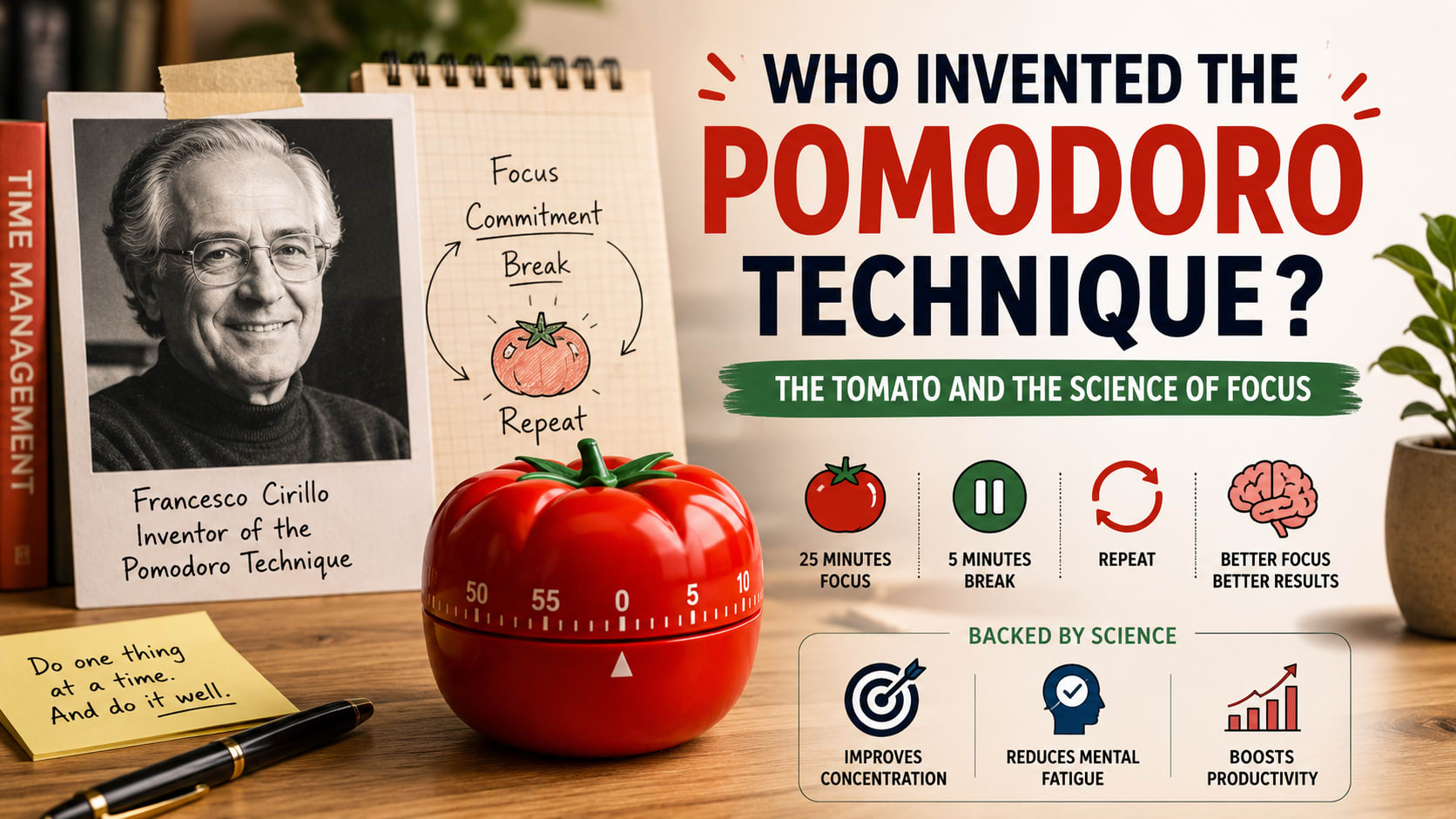
There is a decent chance that the most famous productivity method in the world is named after a piece of kitchen plastic shaped like a tomato. Not a metaphorical tomato. An actual wind-up timer, the kind you'd set to remember the pasta, that a stressed-out university student grabbed off a shelf one evening because he was desperate to get something done. That tomato gave its name — and its whole philosophy — to the Pomodoro Technique, and the story of how it happened says a lot about why it works.
Who invented the Pomodoro Technique?
The method was created in the late 1980s by Francesco Cirillo, then a university student in Italy drowning in coursework and unable to concentrate. In a now-legendary moment of self-bargaining, he challenged himself: could he focus, really focus, for just ten minutes? To enforce it he reached for a kitchen timer on his desk — and that timer happened to be shaped like a tomato.
He wound it up, worked until it rang, and something clicked. The simple act of committing to a fixed, short, bounded stretch of time made focus feel possible in a way that "study all evening" never had. He kept experimenting, refining the intervals, and eventually formalised the approach into a method he could teach. He named it after that first timer. "Pomodoro" is simply the Italian word for tomato.
Why is it called "pomodoro"?
That's genuinely the whole reason — there's no hidden acronym or clever theory behind the name. Each focused interval became known as "a pomodoro," and a work session is measured in how many pomodoros it takes. It's a rare case of a serious productivity system keeping the slightly silly, deeply human detail of its origin baked right into the name. Every time someone says "that'll take about three pomodoros," they're unknowingly referencing a student's tomato-shaped kitchen clock from the 1980s.
Why 25 minutes?
The classic pomodoro is 25 minutes of work followed by a 5-minute break, with a longer break after every four. People assume there must be deep neuroscience behind that exact number. There isn't, really — and Cirillo has been honest about this. Twenty-five minutes emerged from experimentation as a sweet spot: long enough to make real progress, short enough that starting doesn't feel daunting.
And that second part is the quiet genius. The hardest moment in any task is the beginning — the friction of starting a two-hour slog is enormous. But "just do 25 minutes" slips under your brain's resistance. You can always do 25 minutes. Once you're moving, momentum usually carries you well past the activation energy that was keeping you stuck. The number isn't magic; the boundary is.
Parkinson's Law and the ticking clock
There's a well-known principle that explains part of the effect. In 1955, the historian Cyril Northcote Parkinson wrote a half-joking essay for The Economist that opened with a line now quoted everywhere: "Work expands so as to fill the time available for its completion." Give yourself a whole afternoon to write an email and somehow it takes the whole afternoon.
A pomodoro flips this. By shrinking the time available to a hard 25-minute box, you create artificial urgency — a gentle, self-imposed deadline arriving in minutes, not days. Tasks that would have sprawled get compressed. The ticking timer turns vague intention into a small, finite sprint, and Parkinson's Law starts working for you instead of against you.
The real enemy: interruptions
Here's where the science gets genuinely sobering. Researcher Gloria Mark, of the University of California, Irvine, spent years studying how people actually work in offices, stopwatch in hand. One of her most cited findings is that after an interruption, it takes on average around 23 minutes to fully return to the original task. Twenty-three minutes — to recover from a single "quick question" or a glance at a notification.
If that's true, then the most precious and fragile thing you have during deep work isn't time; it's uninterrupted time. This is the deeper purpose of a pomodoro that beginners often miss. It isn't just a countdown — it's a shield. For those 25 minutes, you make a pact with yourself: no email, no phone, no "I'll just check one thing." Cirillo built handling interruptions right into the method, with a simple discipline for when a distracting thought or a colleague appears — note it, set it aside, and deal with it after the timer rings, not during. The timer gives you permission to protect your attention, which most of us feel weirdly guilty doing otherwise. Pairing that protected block with a tool like an online Pomodoro timer makes the boundary visible and a little harder to break.
Your brain runs in cycles
The break isn't a reward bolted on at the end — it's load-bearing. Decades ago, the sleep researcher Nathaniel Kleitman proposed that the body runs on a "basic rest-activity cycle," an ultradian rhythm of roughly 90 minutes that continues through our waking hours, not just sleep. Within those cycles our alertness rises and falls; attention is a renewable resource that depletes and needs topping up.
Try to grind for three unbroken hours and you'll feel it: the words stop landing, you reread the same paragraph, your mind drifts to lunch. That's not weakness, it's biology. The Pomodoro Technique works with this rhythm rather than against it, forcing a pause before you hit the wall instead of after. The short breaks let attention recover a little; the longer break after several pomodoros lets it recover a lot. You end the day having done more, precisely because you stopped on purpose.
Why breaks make you sharper, not lazier
There's a stubborn cultural belief that stepping away from work is slacking. The research suggests the opposite. Brief breaks appear to support what some psychologists call diffuse thinking — the loosely-focused mental state where the brain quietly connects ideas and where surprising solutions tend to surface in the shower or on a walk. Stepping away also gives the brain a moment to consolidate what you just learned, and Attention Restoration Theory, developed by Rachel and Stephen Kaplan, argues that low-effort activities (especially a glance at nature) help replenish directed attention.
The catch is that the break has to actually be a break. Spending your five minutes doomscrolling keeps the same attentional machinery firing and defeats the purpose. The most restorative pomodoro breaks are the analog ones: stand up, stretch, look out a window, refill your water. Boring, and that's the point.
It was never really about the timer
Strip the Pomodoro Technique down and the timer is almost incidental. What it's really teaching is single-tasking in a world engineered for the opposite. One task, one block, full attention, then a real rest. The technique just wraps that hard behaviour in a friendly, low-stakes container — 25 minutes, a tomato, a satisfying ring — so it's easy to start and easy to repeat.
That reframing matters. Most people fail at focus not because they lack discipline but because they try to summon it through sheer willpower against an environment full of pings. A pomodoro replaces willpower with structure. You don't have to decide to keep focusing every thirty seconds; you decided once, at the start of the block, and the timer holds you to it.
One size doesn't fit all
The 25/5 split is a starting point, not scripture, and plenty of people tune it. A widely shared study of highly productive software users found a rhythm closer to 52 minutes of work and 17 of rest. Fans of deep, creative work often prefer riding a single ~90-minute ultradian wave before a substantial break. Others use "flowtime," where you simply note when you start, work until your focus naturally fades, and then rest — letting the session length find itself.
The right interval depends on the task and on you. Shallow admin work suits short, punchy pomodoros; demanding creative work may need longer runways. The principle underneath them all is identical, and it's the principle Cirillo stumbled onto with his tomato: choose a bounded stretch of time, defend it from interruption, give it your whole mind, and then genuinely rest before the next one.
The humble tomato, still ticking
It's a lovely thing that a method now taught in companies and used by millions of students traces back to a panicked undergraduate and a piece of kitchen kit. There's no expensive app required, no productivity guru's system to buy into. The original tool cost a few lira and looked like a vegetable.
So the next time you set a timer and promise yourself 25 honest minutes, you're running a little experiment that's been replicated countless times since the 1980s — and one that quietly lines up with what we know about deadlines, distraction, and the rhythms of human attention. Wind it up, guard the time, and let the tomato do the rest.
