Who Invented Kanban? From a Toyota Factory to Your Screen
Kanban was born on a post-war Japanese factory floor and shaped by an American supermarket. Here's the surprising history — Taiichi Ohno, the pull system, WIP limits, Little's Law, and how it became t
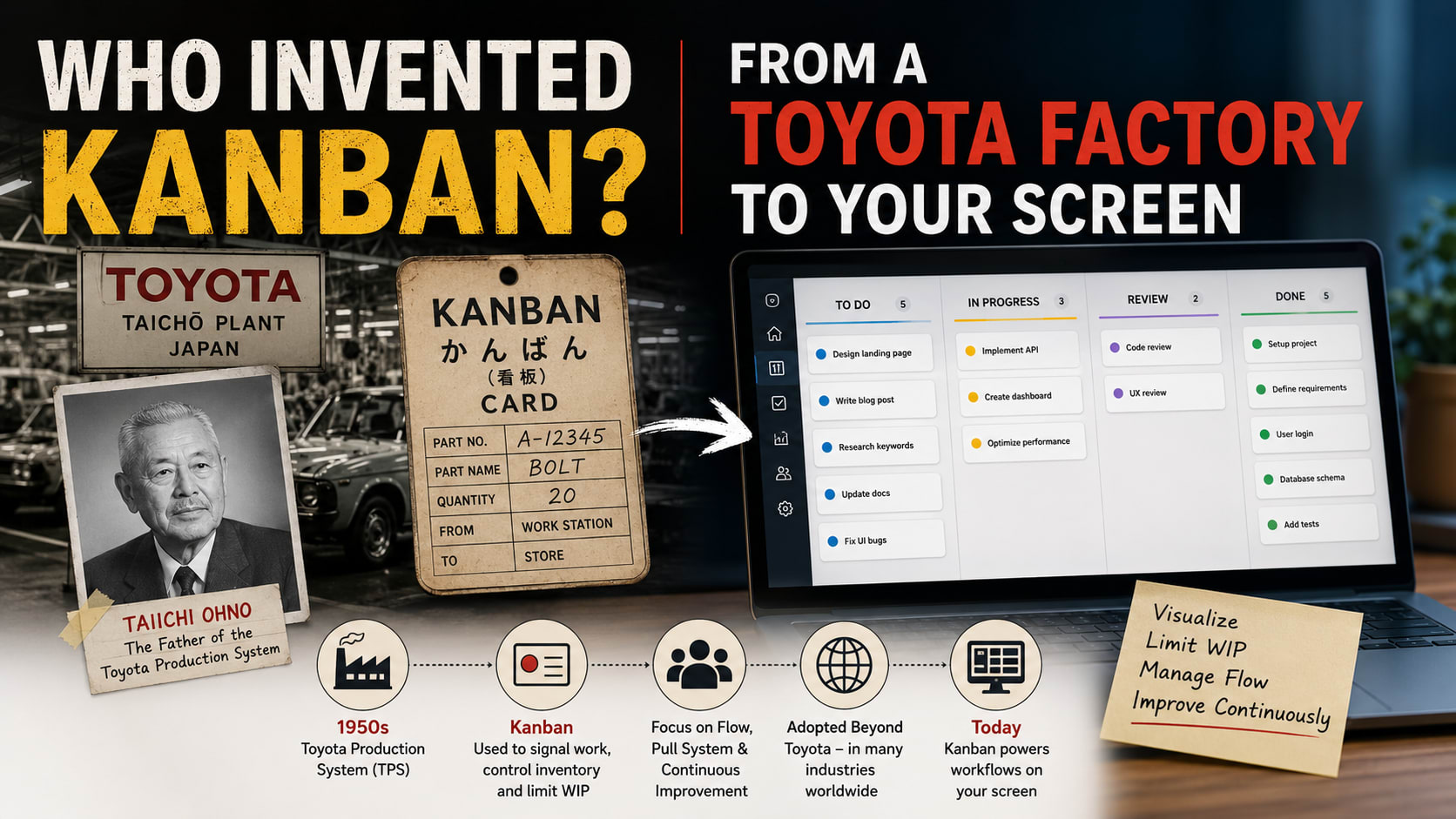
Most of the productivity tools we lean on every day were dreamed up in offices, by software people, for software problems. Kanban wasn't. It was born on a noisy factory floor in post-war Japan, shaped by a trip to an American grocery store, and only decades later did it slip quietly into the world of sticky notes, software teams, and the little drag-and-drop boards so many of us now keep open in a browser tab. It's one of the great unlikely journeys in the history of work — and once you know it, you never look at a "To Do / Doing / Done" board quite the same way.
What does "kanban" actually mean?
Let's start with the word, because it gives the whole game away. Kanban (看板) is Japanese for "signboard" or "billboard" — the kind of visual sign a shop hangs out front. That's the essence of the method: make the work visible. Before kanban was a methodology, it was literally a card, a physical signal you could see and pass from hand to hand. The genius wasn't a complex algorithm; it was the decision to take invisible work and pin it to a board where everyone could look at it.
Hold onto that idea, because it explains why a kanban board feels so satisfying even in its simplest form. You're not just tracking tasks. You're turning the abstract — everything swirling around in your head — into something physical you can move.
The man behind it: Taiichi Ohno
The story really begins with Taiichi Ohno, an engineer at Toyota in the years after the Second World War. Japan's economy was shattered, resources were scarce, and Toyota was a small carmaker that could not afford the American approach of building enormous stockpiles of parts and finished cars. Ohno was given a brutal challenge: match the productivity of American factories without their cash, their scale, or their warehouses full of inventory.
Out of that constraint he built what became the legendary Toyota Production System, and kanban was one of its beating hearts. Ohno's obsession was waste — muda, in Japanese — and few things waste more money than parts sitting around waiting to be used, or half-built cars piling up because one station got ahead of the next. He wanted a factory where nothing was made until it was actually needed.
The supermarket that inspired a revolution
Here's the twist nobody expects. The key insight didn't come from another car factory. It came from a supermarket.
Ohno had heard about American self-service grocery stores and was fascinated by how they worked. In a traditional shop, a clerk fetched everything for you. In an American supermarket, customers took products off the shelves themselves — and crucially, the store only restocked a shelf when it started to empty. The customer's act of taking an item was the signal to replenish it. Nothing was over-ordered; the shelf "pulled" new stock from the back exactly as fast as people bought it.
Ohno was so taken with this that he finally visited the United States in 1956 to see it with his own eyes. He realised a factory could work the same way: each stage of production should be like a shelf, only making more when the next stage "took" what it had produced. The downstream step pulls from the upstream step, never the other way around. A car assembly line, reimagined as a very disciplined grocery store.
Push versus pull: the idea that changes everything
This is the philosophical core, and it's worth slowing down for. Most systems are push systems: work is shoved forward as fast as each stage can produce it, whether or not the next stage is ready. The result is familiar to anyone who has ever worked anywhere — bottlenecks, piles of half-finished things, and a lot of stuff "in progress" that isn't actually moving.
Kanban flips this into a pull system. Work only advances when there's capacity to receive it. The signal to start something new comes from completion downstream, not from ambition upstream. On the factory floor, that signal was a physical kanban card returning to the previous station, saying, in effect, "I'm ready for more." No card, no new work. It was a beautifully simple way to stop everyone from drowning.
The cards on the floor
In Toyota's plants, those cards became a precise language. A kanban card attached to a bin of parts told you exactly what to make, how many, and where to send them. When a bin was emptied, its card travelled back up the line as a reorder. There was no central computer barking instructions; the system regulated itself through cards moving around the floor. Production became a quiet, self-balancing conversation rather than a top-down command.
It worked spectacularly. The Toyota Production System became one of the most studied manufacturing approaches in history, and "just-in-time" production — making things exactly when needed — reshaped industries far beyond cars.
From cars to code
For decades, kanban stayed a manufacturing idea. The leap to knowledge work came in the 2000s, largely through David J. Anderson, who was wrestling with a very different kind of factory: software teams. Software has no physical bins or shelves, but it has the same disease — too much started, not enough finished, work invisibly stuck in someone's head or inbox.
Anderson took Ohno's principles and adapted them for teams of people whose "product" was ideas and code. His version, often called the Kanban Method, boiled down to a few deceptively simple practices: visualise your work on a board, limit how much can be in progress at once, and manage the flow of work rather than the busyness of people. Crucially, it didn't demand that teams blow up their existing process. You start with what you do now, make it visible, and improve gradually. That gentleness is a big part of why it spread.
If you've ever dragged a card from "Doing" to "Done" on a free online Kanban board, you've used Ohno's supermarket logic and Anderson's software adaptation at the same time, probably without realising either.
Why limiting work-in-progress makes you faster
The single most counter-intuitive lesson of kanban is this: doing fewer things at once makes you finish more.
It feels wrong. Surely starting more work means more gets done? But every task in progress carries a hidden tax. Switching between them costs time and focus — studies of context switching suggest it can devour a serious chunk of a knowledge worker's day. Worse, a task that's "80% done" delivers exactly zero value until it's actually finished. A pile of half-done work is a pile of nothing, just with more anxiety attached.
This is why mature kanban boards add WIP limits — an explicit cap on how many cards can sit in a column at once. The "In Progress" column might be limited to, say, three cards. Hit the limit and you're not allowed to start anything new; you have to help finish what's already moving first. It forces a team (or a person) to swarm on completion instead of scattering attention.
Little's Law: the quiet math of flow
There's even a piece of mathematics underneath all this, and it's elegant. In 1961, an MIT professor named John Little proved a relationship now known as Little's Law. Stated for our purposes, it says:
Average lead time = Work in progress ÷ Throughput
In plain English: how long something takes to get done depends on how much work is in the system divided by how fast you complete things. The implication is striking — if you want work to move through faster, one of the most reliable levers is simply to reduce how much you have in progress. Less stuff in the pipe, shorter wait. The math agrees with the intuition that limiting WIP speeds everything up. It's rare for a productivity belief to have a proof behind it; this one does.
The psychology of a moving card
Kanban also quietly exploits how our minds work. In the 1920s, a psychologist named Bluma Zeigarnik noticed that waiters could remember unpaid orders in remarkable detail, but forgot them almost instantly once the bill was settled. The phenomenon — now called the Zeigarnik effect — is that unfinished tasks occupy the mind and create a low hum of mental tension, while completed ones release it.
A kanban board is a machine for relieving exactly that tension. Every unfinished task lives outside your head, on the board, where your brain can stop nervously rehearsing it. And the act of sliding a card into "Done" delivers a small, genuine hit of closure. That little drag-and-drop is doing more psychological work than it looks.
Kanban versus Scrum
Because they often appear together, people frequently ask how kanban differs from Scrum, the other famous agile approach. The short version: Scrum organises work into fixed time-boxes called sprints, with defined roles and ceremonies, and you commit to a batch of work for each sprint. Kanban has no sprints, no required roles, and no fixed batches. Work flows continuously; you pull the next item whenever you have capacity, and you can change priorities at any moment without waiting for a sprint to end.
Neither is "better" — they suit different rhythms. Scrum brings cadence and ritual; kanban brings flexibility and flow. Many teams blend them. But for an individual managing their own tasks, kanban's come-as-you-are simplicity is usually the easier place to start: a few columns, some cards, and a habit of moving them rightward.
A signboard, still doing its job
It's a strange and rather lovely lineage. A cash-strapped engineer studies a grocery store, invents a system of cards to tame a car factory, and seventy years later that same idea sits in a browser tab helping a student plan exams or a freelancer juggle clients. The technology changed completely; the insight didn't. Make the work visible. Pull, don't push. Finish before you start. Watch it flow.
So the next time you move a card from one column to the next, give a small nod to Taiichi Ohno and his supermarket epiphany. You're using one of the twentieth century's quietest, most durable good ideas — a signboard, still doing exactly what it was invented to do.
