The Space Between Two Shots: Why Joining Clips Is Where Movies Are Really Made
In 1918 Lev Kuleshov joined one blank shot of an actor's face to three different images, and audiences swore they saw hunger, grief and desire. Nothing changed on the face — everything happened in the
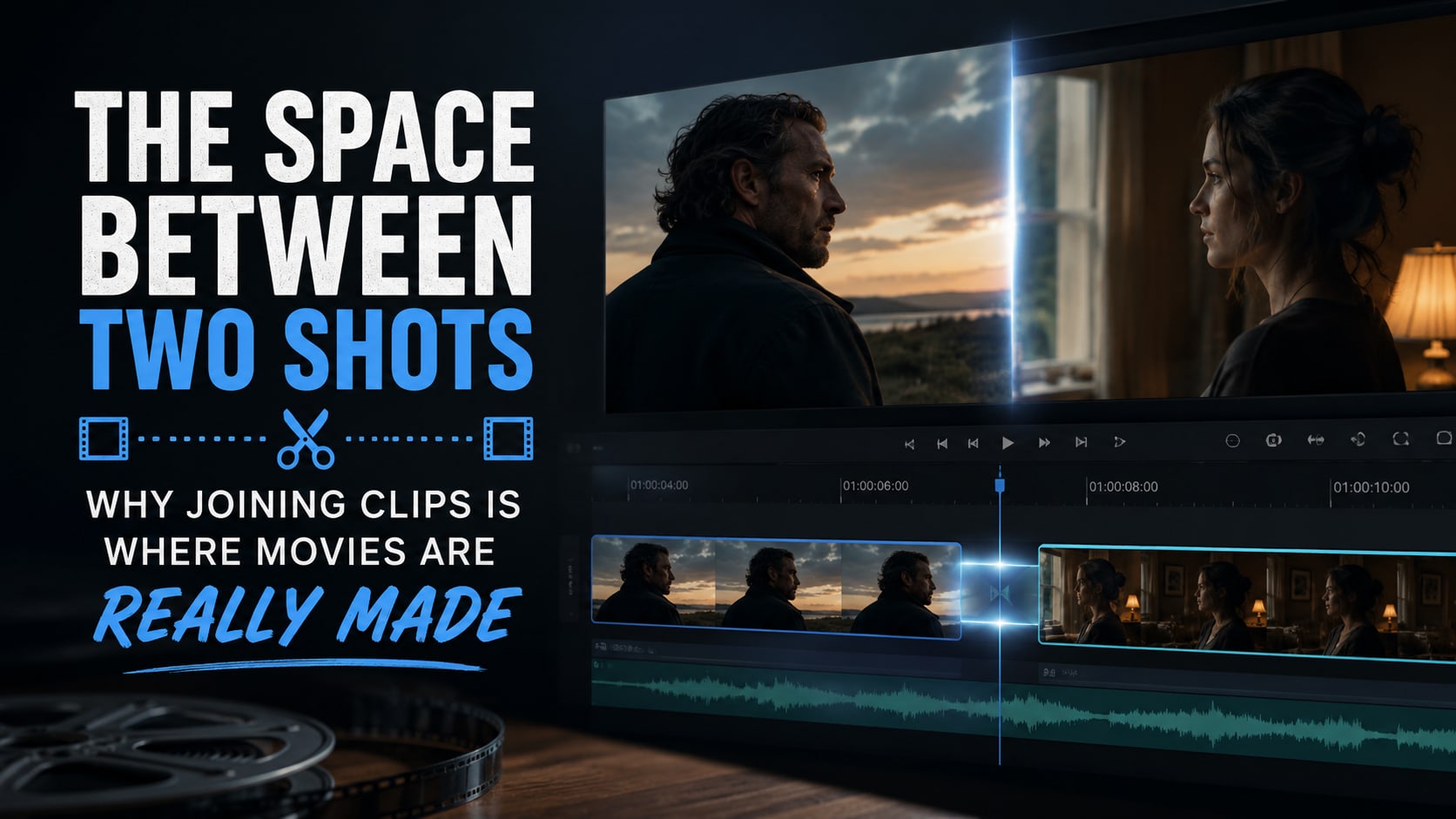
The Space Between Two Shots: Why Joining Clips Is Where Movies Are Really Made
Sometime around 1918, in a cold and broke post-revolutionary Moscow, a young film teacher named Lev Kuleshov ran an experiment so simple it sounds like a parlour trick. Film stock was scarce — so scarce that his students sometimes practised by re-cutting old prints they already had. With almost nothing to work with, Kuleshov took a single, neutral close-up of a well-known actor named Ivan Mozzhukhin. The actor's face was doing nothing in particular; just a calm, blank expression, the cinematic equivalent of a held breath.
Then Kuleshov joined that same identical shot of the face to three different shots in turn. First: the face, then a bowl of soup. Next: the same face, then a child in a coffin. Finally: the same face, then a woman reclining on a couch. He showed the three little sequences to audiences and asked what they saw.
The audiences raved about the actor's performance. After the soup, they said, his face showed hunger — what subtle yearning! After the coffin, they saw grief — such restrained sorrow. After the woman, desire — what tenderness in his eyes. They praised the range, the depth, the emotion of a man whose face had not changed by a single muscle across all three. It was the same frame of film every time.
Nothing had happened on the actor's face. Everything had happened in the join. And that join — the invisible seam where one shot ends and the next begins — is the single most important idea in the history of moving pictures. It is also, as it happens, exactly what you are doing when you drop a few clips into a video merger and combine them into one. You are not just gluing files end to end. You are building meaning in the gaps.
The brain does the editing, not the screen
Here is the strange and wonderful truth that the Kuleshov effect revealed: a film is not really on the screen. A film is assembled inside the viewer's head. The screen only ever shows you one image at a time. The story — the cause and effect, the emotion, the sense that these separate pieces belong to one continuous world — is something your brain manufactures, automatically and irresistibly, every time two shots are placed next to each other.
Show someone a man looking off-screen, then a shot of a ship on the horizon, and they will swear the man is looking at the ship — even if those two pieces of film were shot years apart, on different continents, with no ship ever in the actor's eyeline. Show a hand turning a key, then a door opening, and the viewer constructs a single fluid action out of two unrelated fragments. We are, all of us, compulsive pattern-completers. Hand the brain two adjacent images and it will build a bridge between them whether you ask it to or not.
This is why editing — the specific craft of deciding what goes next to what — is sometimes called the only art form truly native to cinema. Acting predates film. Photography, music, writing, set design: all older. But the cut, the deliberate joining of one piece of recorded time to another to create a meaning that exists in neither piece alone, was something the movies invented. Kuleshov's students, including a young firebrand named Sergei Eisenstein, would spend the 1920s turning this discovery into a whole theory. Eisenstein called it montage, from the French monter, "to assemble," and he believed the collision of two shots produced a third thing — an idea — like two chemicals reacting. Shot A plus shot B did not equal "A then B." It equalled something new.
Continuity: the invisible craft of not noticing
Most of the cuts you see in a normal film or a polished video are working hard to be invisible. This is the school of editing called continuity, and its entire goal is to join shots so smoothly that you never register the join at all. The whole grammar of mainstream film — cutting on action, eyeline matches, the famous "180-degree rule" that keeps characters on consistent sides of the screen — exists to keep your brain's bridge-building running so frictionlessly that two hours of thousands of separate shots feel like one unbroken experience.
When continuity breaks, you feel it instantly, even if you can't name it. A character's glass is full, then empty, then full again. Someone's jacket is buttoned, then open, then buttoned. These "continuity errors" are catalogued obsessively by fans precisely because they puncture the illusion — they remind you that the seamless world was stitched together from pieces. The fact that we notice them at all proves how powerfully the join usually works on us.
For everyday video — combining clips from a holiday, stitching together a how-to, assembling a highlights reel — you don't need to memorise film-school rules. But the underlying principle is worth keeping in your pocket: the order in which you join your clips is not neutral. Put the calm establishing shot first and the action second, and you've set a scene. Reverse them and you've created a flashback or a mystery. The same clips, joined in a different order, tell a different story. That's the Kuleshov effect quietly working in your own footage.
The jump cut: when filmmakers learned to break the seam on purpose
For decades the invisible join was the gold standard, and a visible, jarring cut was considered a mistake. Then in 1960 a French director named Jean-Luc Godard released Breathless and deliberately did the "wrong" thing: he cut out chunks from the middle of continuous shots, so the image leaps forward in time with a visible little stutter. These are jump cuts, and at the time they were scandalous — they drew attention to the seam instead of hiding it.
You will recognise jump cuts immediately, because they have since become the native language of online video. Nearly every talking-head video, vlog, and tutorial is built from them: the creator records, pauses, removes the dead air and the stumbles, and the result jumps from sentence to sentence with that characteristic energetic snap. What was once an avant-garde provocation is now simply how a person talks to a camera on the internet. The seam stopped being something to hide and became something to use.
This is the second great lesson of joining clips: a cut can be a tool of rhythm. The pace at which you move from one piece to the next sets the entire energy of a video. Long, lingering joins feel calm and cinematic; rapid-fire cuts feel urgent and alive. The supercut, the montage sequence, the fast-paced recipe video where two hours of cooking becomes thirty propulsive seconds — all of them are built on the realisation that when you cut is as expressive as what you show.
Why joining clips used to be hard — and quietly still is
If joining shots is so fundamental, why has it historically been so fiddly? Because two pieces of video are rarely born compatible. In the physical-film era, splicing required the strips to be the same gauge and aligned frame-perfectly. In the digital era, the incompatibilities just moved somewhere less visible: clips can have different resolutions, different shapes, different frame rates, different audio settings, even different internal codecs. Naively staple a 4K phone clip to a wide old camcorder file and you get a result that jumps in size, stutters in timing, or drifts out of sync between picture and sound.
This is the unglamorous engineering behind every clean merge, and it's worth understanding because it explains why combining videos sometimes takes a moment of processing rather than happening instantly. To join clips seamlessly, a tool has to first quietly normalise them — scale every clip onto a common canvas (letterboxing the odd shapes rather than stretching them), settle them all to one frame rate, and unify their audio. There's a subtle but crucial detail here: if one clip has sound and the next is silent, the silent one needs a matching silent audio track grafted on, or the soundtrack of the whole merged video slides out of sync after the join. A good online video merger handles all of this for you in the background, which is why you can throw mismatched clips at it and still get a result where the joins don't lurch.
Doing that work used to mean a desktop program, a render queue, and often a watermark stamped across your footage as the price of "free." The interesting shift of the last few years is that the engine that powers professional video software can now run directly inside a web browser, on your own device. Your clips never get uploaded; the matching and stitching happen locally; nothing is stored on someone else's server. The most computationally demanding craft in cinema history fits inside a browser tab — and the only thing leaving your computer is, well, nothing at all.
The seam is the story
There's a reason editors are sometimes described as the invisible authors of film. The director and actors create the raw material — the shots — but it's in the joining of those shots that timing, meaning, and emotion are actually born. Kuleshov proved it with a bowl of soup and a borrowed face a century ago: the audience felt hunger and grief and love in a man who did nothing, because feeling was created in the cut, not the performance.
So the next time you combine a handful of clips — reordering them, deciding which moment leads and which follows, choosing where one ends and the next begins — it's worth remembering that you're working with the oldest magic the movies ever discovered. You're not just merging files. You're deciding what story the gaps will tell. Give it a try and watch your own footage become more than the sum of its clips: merge a few videos into one and pay attention to what happens in the seams. That's where the movie really lives.
