The Great Orientation War: Why Video Still Can't Decide If It's Tall or Wide
Cinema spent a century teaching us video is wide. Then a few billion people put a camera in their pocket and held it upright. The story of 'Vertical Video Syndrome', the ergonomics that beat aesthetic
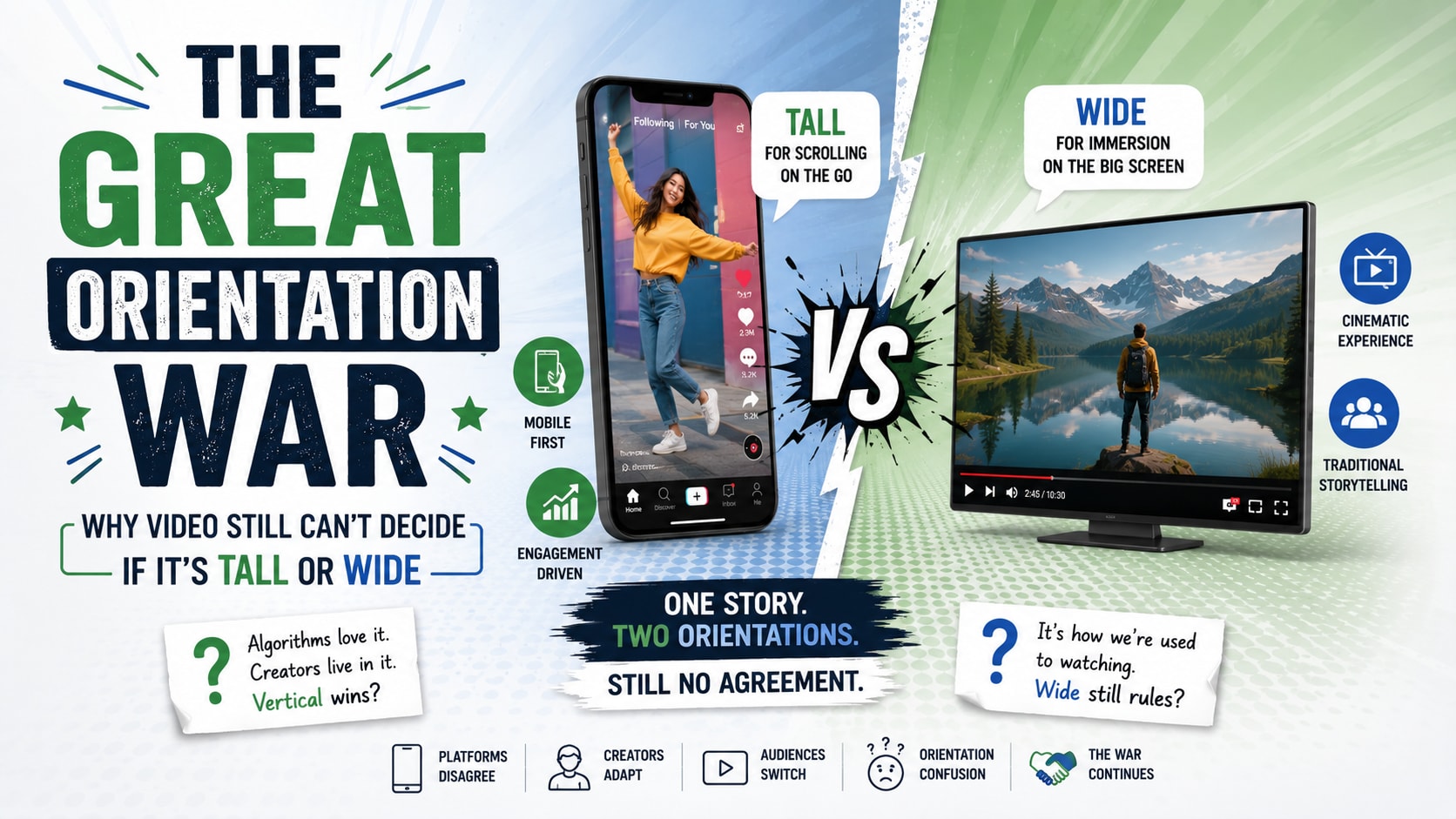
The Great Orientation War: Why Video Still Can't Decide If It's Tall or Wide
Hold your phone up to film a friend blowing out birthday candles. You turn it sideways, because that's what feels "proper." Your friend, filming you back, holds theirs upright because that's how the phone naturally sits in a hand. Later you try to watch both clips on a laptop and one of them is a tiny strip floating in a sea of black bars, while the other fills the screen but cuts off everyone's feet. Somewhere in that small domestic comedy is one of the longest-running, most quietly bitter design arguments in the history of moving pictures: should video be wide, or should it be tall?
This is not a trivial question, and it has no settled answer. It's the reason a clip can look perfect on the device that shot it and absurd everywhere else — and the reason a video rotator is one of those tools almost everyone ends up needing sooner or later. To understand why your footage keeps ending up the wrong way round, you have to understand a fight that's been running for a century.
Why "wide" won the first hundred years
For most of the history of film and television, wide was simply the law. Cinema screens were horizontal rectangles, televisions were horizontal boxes, and every camera, every editing room, every broadcast standard assumed the world was landscape. There were two genuinely good reasons for this, one biological and one historical.
The biological reason is sitting in your skull. Human eyes are set side by side, not stacked vertically, which gives us a field of view that is far wider than it is tall — we take in roughly 200 degrees horizontally but much less vertically. We are built to scan a horizon, to notice movement coming from the side, to see the lion in the long grass. A wide frame mirrors the way we actually look at the world, which is why a sweeping landscape shot feels natural and immersive while the same scene squeezed into a tall slot feels cramped and claustrophobic.
The historical reason is momentum. Early cinema settled on a shape close to 4:3 — slightly wider than a square — known as the Academy ratio, after the film academy that standardised it in the 1930s. Then, in the 1950s, the movie industry panicked. Television was luring audiences out of cinemas, and Hollywood's counterattack was spectacle: screens got dramatically wider. CinemaScope, VistaVision, Panavision — a parade of ultra-wide formats designed to deliver something a living-room TV never could. Wide became a synonym for cinematic, for epic, for important. When television itself eventually went widescreen, shifting from the boxy 4:3 to the now-universal 16:9 in the high-definition era, the victory of horizontal seemed total and permanent. Everything was wide. Wide was correct. Wide was the only way a serious picture could look.
And then a few billion people put a video camera in their pocket — and held it the wrong way.
The accidental rebellion of the upright phone
Here is the engineering quirk that started the war's second act. A phone is a tall object. You hold it upright to read a message, to scroll, to make a call. The camera is bolted into that tall body in a fixed orientation. So the natural, one-handed, thumb-on-the-button way to grab a quick video is to point the phone as you're already holding it — vertically.
The phone itself doesn't mind. Like its photo cousin, a phone usually films in its single physical orientation and tags the file with a small piece of metadata, a flag that says "display this upright" or "display this rotated." The phone reads its own gravity sensor at the moment you hit record and writes that note so the playback comes out the right way up on the same device. The trouble starts when the file travels. Some players and platforms honour that little rotation flag; others ignore it entirely. A clip that's perfectly upright on your phone can arrive at a friend's older media player lying flat on its side, because that player never read the note. Truly rotating the pixels — baking the orientation into the frames themselves rather than relying on a flag — is the only thing that fixes it for every player, everywhere. That, in a sentence, is the whole job of rotating a video properly rather than just tilting it on screen.
But the metadata mix-up was only the technical half of the problem. The cultural half was louder.
"Vertical Video Syndrome": the great backlash
Around 2012, as smartphone clips flooded YouTube, a wave of irritation crested among people raised on the gospel of widescreen. A comedy PSA titled with the mock-medical phrase "Vertical Video Syndrome" went viral, lampooning the tall clip as a kind of affliction — those two thick black bars on either side of a thin ribbon of footage, wasting most of a landscape screen. For a few years "VVS" became a genuine internet shaming ritual. To shoot vertical was to mark yourself an amateur. Tech bloggers wrote stern explainers. Well-meaning friends would mime rotating their hands at you: turn the phone, turn the phone.
The scolds had a real point, but only within their own assumptions. Vertical video looks wrong on a horizontal screen. The black bars are real, the wasted space is real. The unexamined premise was that the horizontal screen was the natural home of all video — the same premise cinema and television had spent a century installing in everyone's heads. What nobody quite noticed was that the screen most people now watched on was no longer horizontal. It was the tall slab in their hand, held upright almost all the time.
How vertical struck back
The counter-revolution came not from filmmakers but from product designers who simply looked at how people actually held their phones. If the screen is vertical and the hand is vertical and the natural grip is vertical, then forcing every video into a horizontal box means the viewer has to either rotate the whole phone or accept a tiny picture. Why fight the hand?
Platforms built around the upright phone changed the rules deliberately. Disappearing "Stories" arrived as full-screen vertical. Short-video apps made the tall 9:16 frame — the exact inverse of widescreen 16:9 — the default, the standard, the correct shape. A video that filled the whole phone, edge to edge, with no bars and no rotating, suddenly felt more immersive than a respectful little letterboxed rectangle. The very thing the widescreen purists had mocked became the most engaging format on the most-used screens on Earth. Vertical didn't win on aesthetics; it won on ergonomics. It fit the hand.
The result is that we now live in a genuinely two-orientation world, the first in the history of the medium. Cinema and television and laptops remain stubbornly horizontal, because they're watched from a distance by eyes that like a wide view. Phones, in the moment-to-moment churn of everyday watching, are overwhelmingly vertical. Neither is going away. A clip born on one is constantly being asked to live on the other.
Which is why we rotate
This is the unglamorous, practical bottom line of a hundred-year argument. Because two incompatible orientations coexist, footage is perpetually arriving in the wrong shape for where it needs to go. You filmed a moment upright for yourself and now you want to drop it into a widescreen montage for the family TV. You grabbed a clip sideways without thinking and now it's lying on its back on your computer. Someone sent you a video that a stubborn old player has flipped onto its side because it ignored the rotation flag. Maybe you mounted a phone or an action camera upside-down and the whole world came out inverted — a 180° problem with a one-click answer.
Rotating a video sounds like it should be the simplest edit imaginable, and conceptually it is: turn the frame 90° clockwise, 90° the other way, or a full 180°, and optionally mirror it left-to-right or top-to-bottom. The subtlety is that a quarter-turn doesn't just spin the picture — it swaps the dimensions. A 1920×1080 landscape clip becomes a 1080×1920 portrait one; what was wide is now tall, and vice versa. That single fact is the entire orientation war in miniature: turning a video isn't decoration, it's choosing which of the two warring shapes your footage is going to be. A good rotator shows you that new size as you turn, so there are no surprises when the file lands on its destination screen.
There's also a meaningful difference between rotating and flipping that's worth keeping straight. Rotating turns the frame like a clock hand. Flipping mirrors it — a horizontal flip swaps left and right, which is the fix for selfie-style footage that looks subtly "backwards" because the front camera mirrored it, and a vertical flip swaps top and bottom. Rotation changes which way is up; flipping changes which way is round. Most of the time you want rotation; occasionally, for that mirrored-selfie weirdness, a horizontal flip is exactly the thing.
A war with no winner, and that's fine
It's tempting to want this resolved — for someone to declare, finally, whether video is tall or wide. But the honest answer is that it depends entirely on the screen and the moment, and both kinds of screen are now permanent fixtures of life. The lesson of the orientation war isn't that one side was right. It's that the "natural" way to frame a moving image was never natural at all; it was a habit, installed by whatever rectangle we happened to be staring at. Cinema taught us wide. The phone taught us tall. Both were just rectangles we agreed to believe in.
So the next time a clip turns up sideways and some part of your brain tuts that it was filmed "wrong," it's worth remembering there was never a right — only a mismatch between the shape it was born in and the shape it now needs to be. That mismatch is fixable in seconds: rotate or flip your video, watch it snap into the orientation you actually want, and send it on its way. The war rages on; your footage, at least, can sit the right way up.
