The Kansas Farm the Whole Internet Blamed: How IP Geolocation Really Works
For years a quiet farm in Potwin, Kansas was accused of the internet's crimes — all because of a rounding error in how IP addresses get mapped to places. Here's what your IP really reveals, and why it
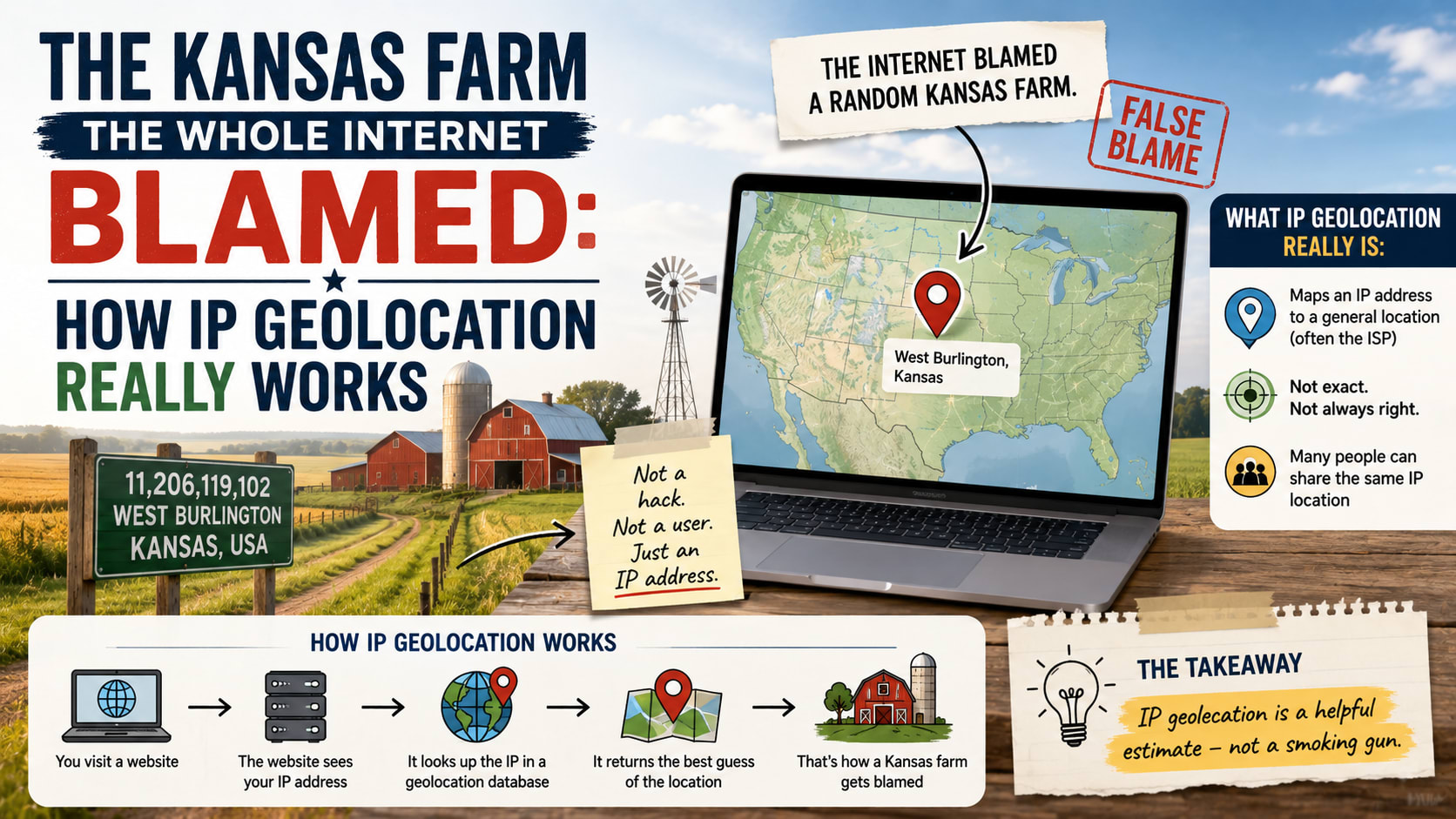
For more than a decade, a quiet 360-acre farm near the tiny town of Potwin, Kansas, was — according to the internet — the home of scammers, fraudsters, stalkers, identity thieves and runaway children. Furious strangers showed up at the door. Law enforcement came looking for stolen phones. One couple who rented the property fielded a relentless stream of accusations for things they'd never done, committed by people they'd never met, somewhere else entirely.
The farm hadn't done anything. It was the victim of a rounding error — a default setting buried inside the imperfect science of figuring out where an internet address is. And that story, strange as it is, is the perfect way to understand what your own IP address really reveals about you, and what it absolutely doesn't.
First, what an IP address actually is
Every device that talks to the internet needs an address so replies can find their way back — exactly like a postal address for your data. That's your IP address. When you load a page, your request carries your public IP, the server sends the page back to it, and the conversation works. Without it, the internet simply couldn't route anything.
Crucially, you don't choose this number and it isn't secret. Your internet provider assigns it, and every website, app, game server and email host you contact can see it. That's not a bug; it's how the system functions. The interesting questions are: where does that number come from, and how much can someone learn from it? You can see your own at any time with a what-is-my-IP tool — but the number itself is only half the story.
Nobody actually stores "this IP is in this town"
Here's the first surprise. There is no master directory mapping every IP address to a street corner. IP addresses are handed out in big blocks by five regional authorities — the Regional Internet Registries, which cover the Americas, Europe, Asia-Pacific, Latin America and Africa. They allocate ranges to internet providers, who then dole them out to customers. None of this paperwork says where a given address physically is in any precise sense; it mostly says which company controls it.
So how does a website guess your city? Companies build geolocation databases by stitching together clues: which provider owns the block, where that provider operates, the physical routes data takes and how long it takes to travel them, and sometimes location data people have volunteered. The result is an educated estimate, and the accuracy is wildly uneven. Country-level guesses are right almost all the time. City-level guesses are right often — but "often" is doing a lot of work. The system frequently knows only that you're somewhere in a country or a broad region, and has to decide what to do with that uncertainty.
The rounding error that haunted a farm
This is exactly where Potwin comes in. One of the biggest geolocation providers, MaxMind, faced a simple problem: when it could tell an address was in the United States but couldn't pin it any closer, it still had to return some coordinates. The engineers picked a round, tidy default — roughly the geographic centre of the contiguous United States, at 38°N, 97°W.
They almost certainly never thought about what was physically sitting at that exact point. What was sitting there was a farm. As journalist Kashmir Hill documented in 2016, that single default caused the coordinates of around 600 million IP addresses to resolve to one rural property in Kansas. Anytime someone tried to trace a scammer, a threat, or a stolen device whose IP could only be placed "in America," digital maps pointed a confident red pin straight at that farmhouse. The residents endured years of suspicion and visits for crimes that were, in reality, untraceable. MaxMind eventually nudged its default coordinates into the middle of a lake to stop sending angry people to anyone's doorstep.
The lesson is bigger than one farm. It shows that IP geolocation is not a precise readout of where you are — it's a best guess, complete with fallbacks, approximations and the occasional absurd artefact. When a website greets you with the wrong city, you're seeing the same machinery that once blamed a Kansas farm for the sins of the entire internet.
Why your IP rarely points to your actual home
Even when the guess is "good," it's usually not pointing at you. A few realities get in the way.
Most home connections use a dynamic IP that your provider rotates periodically, so the address tied to you today may belong to a neighbour next week. Many connections — especially mobile data — sit behind carrier-grade NAT, where a single public IP is shared among hundreds or thousands of customers at once; geolocation can only place that shared address at the provider's regional hub, often a city away from any individual user. And the address almost always reflects your ISP's infrastructure, not your living room. That's why your IP location might show a city you don't live in, or the location of a data centre your traffic passes through.
The honest summary: your public IP reveals your approximate area and who provides your internet. It does not reveal your name, your street, or who you are. Linking an IP to a specific person normally requires the provider's private records, which are only handed over through a formal legal process. Day to day, your IP is more like the postmark on a letter than a signature.
The address space that ran out
There's another twist hiding in those numbers. The original system, IPv4, allows for about 4.3 billion unique addresses — a figure that felt limitless in the early 1980s and turned out to be nowhere near enough for a planet of phones, laptops, smart TVs and internet-connected doorbells. The pool of fresh IPv4 addresses was officially exhausted years ago, which is precisely why carrier-grade NAT exists: providers had to start sharing the addresses they had.
The long-term fix is IPv6, a vastly larger format offering around 340 undecillion addresses — enough to give every grain of sand on Earth its own, with plenty to spare. It's why a modern address can look like a short, friendly 203.0.113.45 (IPv4) or an intimidating string like 2001:0db8:85a3::8a2e:0370:7334 (IPv6). Many connections now carry both, quietly switching between them, and a good lookup tool will tell you which one you're currently using.
Why websites bother locating you at all
If IP location is so rough, why do sites lean on it constantly? Because even an approximate guess is useful at scale. Streaming services use it to enforce licensing deals, which is why a show available in one country vanishes when you cross a border — the dreaded "not available in your region." Shops use it to show prices in your local currency and language without asking. Banks and login systems use it as a fraud signal: a sudden sign-in from a country you've never visited is worth a second look. Advertisers use it to target by region. None of these uses needs your exact address — they just need a reasonable bet about your country or city, which is precisely what IP geolocation is built to deliver, warts and all.
What about VPNs?
If your IP betrays your rough location and provider, the obvious question is how to change what it says. The common answer is a VPN or proxy, which routes your traffic through a server somewhere else first. Websites then see that server's IP and location instead of yours — connect through a VPN endpoint in another country and, as far as the internet is concerned, that's where you are.
This is also why a thoughtful IP tool can sometimes guess you're using one. If a database flags your address as belonging to a known VPN provider, or if your device's own timezone doesn't line up with the timezone of your IP's supposed location, that mismatch is a strong hint your traffic is taking a detour. It's not foolproof, but it's a neat demonstration of how much can be inferred by simply comparing two small clues.
So what should you take away?
Your IP address is one of the most misunderstood numbers in your digital life. It's not a secret, it's not your identity, and it's not a pin on your house — it's a routable, shareable, often-changing label that places you in a rough area and names your provider. The detail people imagine it contains mostly isn't there, and the detail it does contain is an estimate built from registries, network routes and a few clever guesses, occasionally going hilariously wrong.
Knowing all this is genuinely useful. It tells you why a streaming site thinks you're in the wrong city, why "trace this IP" almost never leads to a real person, why a VPN changes what the world sees, and why that poor Kansas farm spent years getting blamed for the internet's misbehaviour. If you're curious what your own connection is broadcasting right now — the address, the approximate location, the provider, and whether you look like you're behind a VPN — you can check it in seconds with a free IP lookup, and read the result with the healthy skepticism it deserves.
